Tuesday, October 31, 2006

Cosmic Karma, Cosmo Kramer and Underpants Ecstasy

On Bali last week we had a tour guide, Darma (yes, as in Dharma), who had a lot of very insightful stories about growing up in a rustic Balinese village, the island’s traditional society, and the challenges and changes his island faces. For someone wearing a tight-fitting blue tracksuit and who seemed to be concealing a dark past in the Javanese cruise-ship industry, he was remarkably wise.

During our tour, in between un-called-for and frankly gut-wrenching attempts to get us to laugh at a ghastly pun which involved asserting that “BBC” stood for “bananas, bamboo and coconuts”, the puckish yet insightful Darma lucidly described the way that the close-knit village unit perpetuates and preserves traditional Balinese life and ritual, and it really got me thinking. What proportion of what we see as the great achievements of humanity was simply due to old-fashioned peer pressure?

In other words, would any human society, religion, or cultural system of any kind have been possible without the nosy neighbor? I’m not so sure. In fact if you think about it, until recently in almost every nation on Earth, the idea that one of the main points in life was not doing something which would shock the neighbors was the glue which kept the world running. It’s how pyramids and cathedrals got built. Shame. Guilt. Conformity. Religious obligation. Rituals. Holidays. Mass gatherings. Belonging. Ancient Athens, the birthplace of democracy, was also the birthplace of ostracism.

Now, however, mainstream American society is currently based on the idea that nosy neighbors should mind their own damn business, and in fact are liable to get a cap in their ass if they get too nosy. We were raised to believe that the other people around us have no right to tell us jack, and are simply useless lumps to be ignored, exploited or possibly pumped full of lead on our quest to become a President, a billionaire or both. We’re encouraged to think that each American citizen should personally invent his or her own entire outlook on life from scratch without consulting family or the neighbors at all.

As a lifelong ostracised oddball and someone who deeply, deeply detests conformity for conformity’s sake I can’t believe I’m saying this, but I’m starting to wonder if maybe a little more German-style shame wouldn’t be an improvement on the current US outlook. I’m not advocating a return to putting people in stocks or forcing them to wear the shame flute, but I am starting to think that there must be a happy medium in between the antisocial American “individualism at any cost” ideal and the Balinese-style community and religious web of obligations and rituals.

I sometimes wish I had more traditions in my life so I didn’t feel like the proper way to spend an afternoon off is to sit motionless in front of the TV in my underwear. But on the other side of the argument, there are probably thousands of Balinese people who wish with all their hearts they could renounce their majestic time-honored religion and colorful rituals and just sit around in their underwear all day. The answer probably lies somewhere in between, in that magical, elusive place where ancient superstitious ritual meets modern jockey shorts. I think that’s where I want to be.

Saturday, October 21, 2006

The Pregnant Sheep

A Short, Short Story

Written as a writing process project for one of my graduate school classes.

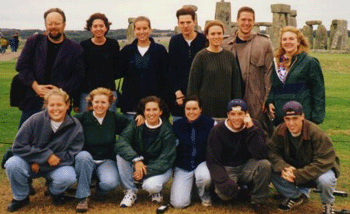
The northern wind chafes my nose and ears. It’s bitter cold on the barren ridge. The rest of my group is clustered downhill, away near the bus. When the wind picks up, I can’t hear them at all. I will myself to believe that it’s two thousand years ago, that I’ve been assigned to guard this frontier against the barbarians. It doesn’t work. Sleepy, hungry and growing cold in spite of my sweater, I am undeniably here, now, in my head, with my thoughts – and my imagination is clearly out of order. Hadrian’s Wall, once a triumph of military engineering, is too low and mossy to seem anything other than quaint. I feel transfixed in the present, and it’s impossible to forget the rest of the group, or the bus. Picking my way unsteadily along the low, broad, jumbled top of the Wall – am I supposed to be doing this? – I move further from the group, and from Kim.

The muted, autumnal English countryside all around is beautiful, but I feel disappointed in the site, in my lack of imagination. This same feeling of curdled anticipation was even worse at Stonehenge earlier this year. I felt nothing looking at it. That’s not true – I felt betrayed. The rocks looked small and somehow artificial. This is less of a letdown, because the Wall isn’t as iconic a sight, but it’s a similar, familiar feeling. I know that berating myself for insufficient awe is absurd, that I should just relax and take everything in, but it’s no use. I’m so preoccupied with analyzing my own feelings and worrying about idiotic details, like a tooth that seems to be getting sensitive and a floating thing in one of my eyes, that I am unable to enjoy the moment. I look away from the bus, off into the fields and into the misty distance. It seems as if it might rain soon. The floating thing inside of my eye bobs up and down in agreement.

A small flock of sheep is grazing on the hillside, with the ancient Roman wall serving as boundary of their enclosure. I hop down from the wall because the next section is too dilapidated to walk upon, and I see a sheep, perhaps 15 feet away, sprawled motionless on its side. Its hindquarters are towards me, and I can see that it is giving birth. Part of a wet membraneous sac is protruding from the sheep, and as I approach I can see the damp folded limbs of the lamb inside. The mother sheep is breathing rapidly, and its eyes are rolling wildly in its head. I stand motionless and watch for a minute. I have never seen anything giving birth firsthand, at least not that I can remember. After some unproductive spasming the ewe’s breathing slows, and its head drops to the damp grass below. It’s clearly exhausted. Kim comes up and we watch together. Neither animal is moving very much, and the mother is breathing very slowly. I have no knowledge of ovine obstetrics but something about the resigned rise and fall of its ribs, the limp splay of its legs on the brownish turf, makes me think the mother sheep has been trapped here in the same position for quite some time. Perhaps hours. “Maybe I should pull out the baby or something – like they always do on TV,” I venture. “Maybe... I have no idea,” Kim says. I stare at the sheep for another minute.

This was my first trip to the north of England. We had all driven up that morning in the bus from Ambleside, in the Lake Country. I was studying abroad in London for the semester, and this was our big group trip. The lakes and Hadrian’s Wall. The Lake Country was beautiful, and we’d just seen Wordsworth’s cottage. These might have been boring destinations for most 20-year-olds, and indeed probably were for some of my classmates, but my girlfriend Kim was visiting and we were enjoying the time together. The long hours in the rented bus (or “coach,” as they called it), however, made me feel queasy and detached from everything. I had always been interested in Roman history, and Roman Britain in particular. Back in London I had sought out museums and sites with Roman remains. But it seemed like a chore to muster enthusiasm for Hadrian’s Wall.

I had trouble mustering enthusiasm for a lot of things that year, actually. Living and studying in London had been wonderful, but as the year had progressed I had been feeling more and more distant from the world around me. I was friends with several of the people on the program, but only up to a point. I enjoyed my classes and exploring London’s streets, but I also felt overwhelmed easily and spent a lot of time reading in my room. I had hardly taken any trips outside the city, and I felt guilty about not taking better advantage of being abroad. When I had free time I would take long walks through the city, usually ending up in a record store and often buying CDs, which was another occasion to feel guilty. They had CDs back in America.

Thus, on the trip to Hadrian’s Wall I was feeling very strange after several months of exciting, educational London life which was, somehow, becoming tainted by vague, creeping unease. The fact that Kim was there made me feel much, much better, but I still felt slightly odd, as if I were watching the world from behind a pane of glass. The long bus rides behind an actual pane of glass didn’t help.

I look at the panting sheep, unable to come to a decision. Aside from our group there’s no one in sight for miles around. I certainly don’t see a gruff farmer or kindly local vet. Kim looks up at me. A chain of thoughts rush in circles through my head.

The sheep seems to be having trouble giving birth.
Should I help in some way?
I have no idea.
I don’t want to get my sweater dirty.
What if I made things worse?
I wouldn’t want to be responsible for a dead lamb.
Better not to interfere.
Maybe I would pull too hard and pull its leg off or something.
And what if I got goop on my sweater?
I just bought this sweater.
It wasn’t an expensive sweater, but I’d have to first take it off.
And then my hair would get all messed up.
Or I could push up the sleeves...
But then wouldn’t the elastic on the wrists get stretched out?
Is this sweater wool?
Maybe I could sort of poke it with a branch, or...
No, it would have to be hands-on.
What is that stuff? Placenta?
Forget it. This is none of my business.
That’s just an excuse. You’re just scared.
But it’s none of my business.
I’ve seen several instances on TV where someone had to pull a baby farm animal out of the mother.
Shouldn’t I do that?
But I have no idea what to do or how to do it.
What would I do with my sweater?


I do not move. I do nothing. The mother sheep’s side slowly rises and falls as it labors to breathe.

As far as I know, I am sentencing both animals to death. Standing and thinking instead of helping. What’s wrong with me? Do other people have this problem? I get a nauseous feeling that tells me that somehow I’ve made the wrong choice, but I can’t make myself do it differently. I’m still standing just feet away but somehow it’s already too late. I had a choice, and I did nothing, simply because doing nothing was the easiest thing to do. I wonder if I saw a human being in need of help, if my nerve would fail me like this. How can I make myself do the right thing? My current method clearly needs work. I’m disgusted at my hesitation, but instead of spurring me to action the disgust makes me want to put the whole situation behind me.

A thought flashes: I haven’t turned away yet; maybe there’s still a chance. Forget the damn sweater and just pull on that baby lamb placenta or whatever that is. The moment passes. The pane of glass descends, the floating thing in my eye pirouettes with glee. It’s time to put this all behind us. As I turn away I feel a dull, toxic satisfaction in having taken the easy route, a poisonous contentment that blossoms black and oily within my brain. I begin to forget that I ever had a choice to make. There was nothing that could have been done. It was none of your business.

“Let’s go back to the bus,” I say to Kim. “I’m getting cold out here.”

Friday, October 13, 2006

Second Life Kind Of Sucks

I have been hearing about this online multiplayer thing called Second Life for a while, and I thought I’d check it out. Big mistake. It goes VERY VERY slowly, at least on my connection, and the program crashes about once every ten minutes. But it seems interesting enough that I keep wanting to try to get it running again, so I get trapped in a hellish, tantalising cycle of waiting and crashing and more crashing and then even more further crashing and rebooting the likes of which have not been seen since I tried to run Rebel Assault on my old 486.

The idea is, people can buy virtual real estate for ten bucks a month or whatever and sublet it, and also create any sort of items they want in the simulation and try to sell them to other people, so the bottom line is the thing supposedly has a GNP of 64 million $US. Seems interesting. I’m not sure I see how the economy works yet. People being what they are, I assume people have found some way to use the simulation for pretend sex while pretending to be various furry animals.

But as I say, it hardly works on my computer. At this point, I’ve got all the graphics options turned as far down as I can get them, and I seem to be barely able to inch my little guy around at a snail’s pace. Half the time he keeps walking in one direction forever and ends up at the bottom of the sea. And then I get booted out of the program. So if you have a fast intarweb connection and a good graphics card, please check the thing out and report back to me. It’s free to create a little character guy. Mine looks more or less like me when I’m dressed for work, except for the tiny details that he doesn’t have glasses and I have him CARRYING A MUTHAFREAKIN SWORD. I really wish the program worked better for me, because strolling around as a virtual version of myself with a goddamned sword is pretty much my lifelong dream.

Monday, October 09, 2006

ease myself into... a body bag

There’s a scene from the movie The Fly that burned itself into my brain. I assume the same thing happened to many of you. You know the scene I mean. Try as hard as I might, I haven’t been able to forget it. It’s the thrilling moment when Jeff Goldblum shows off his wardrobe to the girl. It’s full of several copies of the same outfit, and he says some probably made-up thing about how Einstein wore the same suit every day to save brain power, and that that’s what he does as well.

Whether or not that b.s. about Einstein was true didn’t matter. I immediately felt a connection to the Seth Brundle theory of sartorial simplicity. I wanted to wear the same thing every day. I wanted a uniform. Preferably some sort of ninja costume.

“To save brain power” would be the official reason. The actual reason would be so that I could sleep later and not have to spend time rummaging through annoying piles of itchy, heavy fabric in the morning. I knew that that time could be better used for sleeping. And I can’t stand rummaging. If stuff is on hangers, I always somehow knock it off, and from somewhere along the rod something gives way and all my ties slither onto the floor and shoot off in all directions like a Biblical plague. If the clothes are in piles, the sh*t I want is always far, far towards the bottom, and rummaging through the piles unfolds all the other stuff, and the pile is now somehow half a foot higher than before, and the damn drawer won’t close. I don’t know about you but I’d rather be sleeping than full body wrestling a floppy heap of textiles, thanks. Not to mention that having an official outfit would save me the humiliation of that yearly trip to Bob’s with mom to buy new jams or parachute pants or what have you.

It’s 15 or 20 years later and the dream has not died. Sure, some elements have changed. For example, I now know that Steve Jobs has used a similar approach to clothing, and there’s just something so annoying about Steve Jobs that it almost ruins the monoutfit concept. Also, with the passing years the annual back-to-school shopping trip has turned into a shameful biannual screaming match where Kim tries to convince me that I should buy this or that, and I try to convince her that I am doing just fine with my old clothes. Often I am so violently outraged at having to take off my pants in a shopping mall and carefully measure how much fatter, in inches, I’ve gotten since the last shopping trip, and then pay someone for the honor, that Kim will actually have to buy the clothes for me. I usually end up liking the new clothes eventually, but shopping is such a disgusting ordeal that in the store I am always convinced that no horrible little scraps of fabric are worth that humiliation. Or that money. I’d rather stick with my old clothes. Even if they have worn so thin that the fabric at the knees and crotch is essentially a cobweb or the sheerest of fairy gossamer.

Another compelling reason which I’ve added to my one-outfit theory over recent years: I want some dignity, dammit. Let me explain. First off, I’ve never been a very dignified person. I do not always know which fork to use. I do not carry myself with poise or hauteur. I have been known to slip on icy pavement, walk into glass doors and I have repeatedly picked violent fights with old men in public. And I have worn a t-shirt, jeans and sneakers on most of the days of my life. Nothing wrong with that. But, secondly, living and travelling in other countries has sort of shown me that there’s something I’m lacking. As are most Americans. We have no clothing dignity. We’re slobs in random ugly clothing. Many of us in fact wear only items of clothing with the prefix “sweat-”. If you look at people in the Middle East for example, a lot of them have clothing dignity coming out their ears. A white robe topped with a turban or headscarf makes any random dinar-less schmuck on the street look like the Pope.

Or look at Indian women and saris. They’re basically wearing ancient Roman togas – just a big sheet, really – except with noserings, and it gives an immense aura of importance. I’d just as soon mess with one of them as I’d talk back to Caesar’s wife. Yes, their love handles are hanging out, but darn it they’re hanging out with dignity. Another example – kids in school uniforms look civilized and studious, then when you see them in their normal clothes they look like little imbeciles and jerks. I guess that’s my point – I’m from a country where adults dress like kids who get to pick their own wardrobe. We have no traditions, no urge to dress a certain way, and that has its good aspects but detracts a lot from our clothing dignity.

Anyway, I have no point here except to say that I am trying to turn over a new bolt and am actively working to select and refine my uniform. It’s a work in progress. This summer at school I wore the same thing every day by necessity because I didn’t want to pack too much, but as it involved Converse high-tops and orange shorts, it wasn’t really the most dignified uniform. But it was a start. It is getting late and I’d better stop writing now. I had hoped to add pictures of my actual clothes to add to the excitement. Maybe later. Perhaps in future updates I will continue to elaborate on my unique and fascinating ideas about haberdashery. Now back to sewing my ninja costume.

Monday, October 02, 2006

My Beard of Bees

Indelicate as it might be for a prim young débutante like myself to broach the subject: I perspire rather a lot, here in the primaeval ur-walds of the Federated Malay Territories.

Actually, I don’t perspire. I sweat. Like a frickin hog. I sweat like Nixon’s jowls on debate night. I sweat like Lance Armstrong’s handsome, leather-bound Balzac. I sweat like a cold can of soda on a coasterless coffee table. I sweat so much that my droplets of sweat have tiny droplets of sweat. I sweat so much that by the end of the day the salt incrustations on my t-shirt look like a topographical chart of the Grand Tetons. I sweat constantly, from every pore, even when the fan’s on full blast. It pours off me in cascading sheets of salty, gelatinous filth. I sweat on the balcony. I sweat in the kitchen. I sweat in the bathroom. I sweat WHILE I’M SHOWERING. I hate it.

A lesser man than I, a man whose diet consisted of fewer deep-fried poultry appendages prepared according to the receipt of a certain Col. Harlan Sanders, might have lost weight after all this sweating, but I have not. I think I briefly did, right after we moved here, but it’s all back now, and it’s some kind of perverse vicious cycle because the more fatty folds and flaps I have, the more places for the sweat to seep from, and the more I feel like a Hutt under the merciless gaze of Tatooine’s twin suns.

If this keeps up all I’m going to be able to do is loll grotesquely in a rattan chair on some seedy veranda in a seersucker suit and straw hat, impotently fanning myself and grunting for the cabana boy to bring me another Pernod. Now I see how those guys get like that.

Anyway, for the first six to eight months of my Malaysian sojourn I tried to pay no heed to my incredibly amplified dampness. Water off a duck’s back, I told myself. And yet it was not water, and I was not a duck.

So a few months ago I started to develop a fiery itchiness in several key bodily areas, including the crook of my elbows, behind my ears, and – most tragically – the greasy folds of my neck. Was there a fungus among... me? I suspected so. This was more than simple heat rash. As someone with very little interest in bossing about menials and a blinding paranoia about having strangers in his apartment, I have been carrying out the duties of scullery wench this year, and one afternoon after mopping the apartment in an unbearable agony of sweat and heat, I felt as if my entire body were on fire. I itched, and scratched, and on and on the sweat poured like sweet salty honey from a really gross beehive. The next day, I was all red and puffy.

Thus began my long, slow acceptance of my heat rash, or fungus, or whatever the hell it is. I now try not to move at all, in order not to upset the fiery demon that slumbers within my own skin. My neck is especially itchy, and I spent over a month slathering antifungal crème on it – and now I think the only problem with my neck might have been that I was allergic to the antifungal crème. Either way, it’s itchin like the Dickens. I feel like I’m wearing some sort of mediaeval German neck shame chastity belt. When I walk down the street, I feel as if people can see my crimson, pulsating laryngeal hives from hundreds of yards away.

Yet the one time I went to the doctor to ask about my neck, it suddenly turned smooth and milky-white as a marble statue. She looked at me as if I were utterly barking mad. “I don’t see anything on your neck”, she drawled suspiciously, peering at me as if I were one of those Munchausen Neck Syndrome By Neck Proxy patients she’d heard about on 20/20. I retreated in shame, scratching feverishly at my blazingly inflamed neck-flesh.

And so I come to my present sad condition. Do I have a neck fungus? Probably not. Do I have a neck condition brought on by allergic reaction to neckily-applied antifungal crème? Possibly. All I know is that my frigging neck is really, really, REALLY ITCHY. And covered in sweat.

Friday, September 29, 2006

I don’t think you win a Pulitzer...

...for filth. Just a quick note to say that after recent, exhaustive and still-ongoing research I like both versions of “The Office” exactly, precisely equally. Both shows are really, really funny. The British one is almost too melancholy to bear, which I love, and the American one is slightly more upbeat and a bit closer to my own working experience, which I also love.

The UK one only went on for 14 episodes or so, so it didn’t have a chance to get stale, while the US one has had more time to develop the supporting characters. So... it’s a tie. This is all only really noteworthy because I would have expected not to like the American one, since it’s a copy and since I have always had a sort of embarrassing knee-jerk Anglophilia – but they have done a really good job and the cast is perfect. I honestly couldn’t pick a favourite/favorite if I had to.

The verdict is still out on “Le Bureau” until I can download at least one episode. My hunch is that it sucks. Colossally.

Tuesday, September 26, 2006

what the hell are we doing?

Pfc. Hannah L. McKinney
Hometown: Redlands, California, U.S.

Age: 20 years old

Died: September 4, 2006 in Operation Iraqi Freedom.

Unit: Army, 542nd Maintenance Company, 44th Corps Support Battalion, Fort Lewis, Wash.

Incident: Died from injuries suffered when she was struck by a vehicle in Taji.


Sgt. Adam L. Knox
Hometown: Columbus, Ohio, U.S.

Age: 21 years old

Died: September 17, 2006 in Operation Iraqi Freedom.

Unit: Army Reserves, 346th Psychological Operations Company, U.S. Army Reserve, Columbus, Ohio

Incident: Killed when his patrol encountered enemy forces using small arms fire during combat operations in Baghdad.


Pfc. James J. Arellano
Hometown: Cheyenne, Wyoming, U.S.

Age: 19 years old

Died: August 17, 2006 in Operation Iraqi Freedom.

Unit: Army, 1st Battalion, 67th Armored Regiment, 2nd Brigade, 4th Infantry Division, Fort Hood, Tex.

Incident: Killed when his patrol encountered enemy forces using makeshift bombs and small arms fire in Baghdad.


* * *

Now that you've met these three peppy young kids, why not take a few minutes to get acquainted with their 3,006 buddies?

I am usually not very political, and it unfortunately often takes a graphic representation like the above site to make me really think about what is going on. I won’t make any further comment except to say that we all - those of us who are Americans - share responsibility for these young people’s deaths. Some more than others.

Sunday, September 24, 2006

fourteen signs you are a fascist: THE PREQUEL

My lovely and talented wife recently posted a list of 14 tell-tale characteristics of fascist states – the majority of which are disturbingly applicable to the current presidential administration. I found it quite interesting and thought-provoking, as I do every post on her blog, Follow That Elephant!

However, as usual I couldn’t just leave it at that. I agreed with the article Kim posted but it also provoked my curiosity. Whence had this list come? I am a very skeptical person and, as Kim can testify, I like to try to investigate the original source of things that get spread around the Internet. I wondered if the fascism article might be an urban legend type e-mail forward with no official source behind it, like the one about the Koran, Verse 9:11 or the Julius Caesar quote which was suspiciously anti-Bush. I snooped and snopesed around a bit.

It was an actual article, although the author is not in fact a doctor of political science (as all the versions I have seen claim) but a retired Xerox divisional vice president.
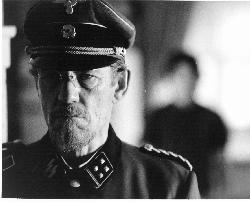
But never mind that. My purpose here is not to pick apart the article or its author. For one thing, as far as I’m concerned, the more people willing to make comparisons between the Bush administration and other misbehaving governments throughout history, the better. Good for him. What I want to do here is share another interesting article I came across during my search.

Apparently, the idea of writing an essay containing fourteen points which define fascism was invented way back in 1995 by none other than one of my very very favorite friggin authors of all time, Umberto Eco. Not that it matters because their content is so different, but our ex-Xerox employee seems to have... er... duplicated... the earlier article’s format.

Why fourteen? Not sure, but whatever the reason the article title shows just why I friggin love Eco so much – it’s a reference to a famous Wallace Stevens poem, possibly my favorite Stevens poem of all. Note the poem’s two references to Connecticut. Anyway yes the ‘14 ways...’ title is just a lame pun but it’s what I live for. Seeing such an electrifying link between my favorite Hartford-dwelling poet and my favorite Milanese intellectual is the sort of thing that fills me with joy. By the way, Stevens was an executive at an insurance company as well as a good poet, so there’s no reason a Xerox vice president can’t be a political commentator. I shouldn’t have been so snide above. Holding down a 9-to-5 or wearing a tie or even being a vice-president of something says little about a person’s inner life.

Anyway, poetic references aside, Eco’s earlier article is a little less obviously applicable to the current administration, but I feel it’s more thought-provoking. While the more recent list concentrates on surface manifestations of what the author deemed fascism, Eco’s original article tried to get to the dark heart of the fascist mentality – its (very successful) tactics of appealing to the reactionary, the primal, the primitive, the xenophobic. I think as many or more of Eco’s points can be applied to militant Islamist attitudes as could be applied to Bush. And so in this disturbing context I present to you the (as far as I know) original text of Eco’s article. Oddly, I couldn’t find this essay anywhere in Italian. Maybe he specifically wrote it for an English publisher. Or maybe I just didn’t look hard enough. I’d be curious to see an Italian version, if anyone can find it. Enjoy the article, and note the disturbing fact that the language of Eco’s anti-fascist conclusion, almost word-for-word, has been twisted toward ur-fascist ends in the last few years. Yikes. And so without further adieu I present:

Eternal Fascism:
Fourteen Ways of Looking at a Blackshirt

By Umberto Eco


Writing in New York Review of Books, 22 June 1995, pp.12-15. Excerpted in Utne Reader, November-December 1995, pp. 57-59.
The following version follows the text and formatting of the Utne Reader article, and in addition, makes the first sentence of each numbered point a statement in bold type. Italics are in the original.
For the full article, consult the New York Review of Books or purchase Eco’s new collection of essays: Five Moral Pieces.

In spite of some fuzziness regarding the difference between various historical forms of fascism, I think it is possible to outline a list of features that are typical of what I would like to call Ur-Fascism, or Eternal Fascism. These features cannot be organized into a system; many of them contradict each other, and are also typical of other kinds of despotism or fanaticism. But it is enough that one of them be present to allow fascism to coagulate around it.

1. The first feature of Ur-Fascism is the cult of tradition.
Traditionalism is of course much older than fascism. Not only was it typical of counterrevolutionary Catholic thought after the French revolution, but is was born in the late Hellenistic era, as a reaction to classical Greek rationalism. In the Mediterranean basin, people of different religions (most of the faiths indulgently accepted by the Roman pantheon) started dreaming of a revelation received at the dawn of human history. This revelation, according to the traditionalist mystique, had remained for a long time concealed under the veil of forgotten languages – in Egyptian hieroglyphs, in the Celtic runes, in the scrolls of the little-known religions of Asia.

This new culture had to be syncretistic. Syncretism is not only, as the dictionary says, “the combination of different forms of belief or practice;” such a combination must tolerate contradictions. Each of the original messages contains a sliver of wisdom, and although they seem to say different or incompatible things, they all are nevertheless alluding, allegorically, to the same primeval truth.

As a consequence, there can be no advancement of learning. Truth already has been spelled out once and for all, and we can only keep interpreting its obscure message.

If you browse in the shelves that, in American bookstores, are labeled New Age, you can find there even Saint Augustine, who, as far as I know, was not a fascist. But combining Saint Augustine and Stonehenge – that is a symptom of Ur-Fascism.

2. Traditionalism implies the rejection of modernism.
Both Fascists and Nazis worshipped technology, while traditionalist thinkers usually reject it as a negation of traditional spiritual values. However, even though Nazism was proud of its industrial achievements, its praise of modernism was only the surface of an ideology based upon blood and earth (Blut und Boden). The rejection of the modern world was disguised as a rebuttal of the capitalistic way of life. The Enlightenment, the Age of Reason, is seen as the beginning of modern depravity. In this sense Ur-Fascism can be defined as irrationalism.

3. Irrationalism also depends on the cult of action for action’s sake.
Action being beautiful in itself, it must be taken before, or without, reflection. Thinking is a form of emasculation. Therefore culture is suspect insofar as it is identified with critical attitudes. Distrust of the intellectual world has always been a symptom of Ur-Fascism, from Hermann Goering’s fondness for a phrase from a Hanns Johst play (“When I hear the word ‘culture’ I reach for my gun”) to the frequent use of such expressions as “degenerate intellectuals,” “eggheads,” “effete snobs,” and “universities are nests of reds.” The official Fascist intellectuals were mainly engaged in attacking modern culture and the liberal intelligentsia for having betrayed traditional values.

4. The critical spirit makes distinctions, and to distinguish is a sign of modernism.
In modern culture the scientific community praises disagreement as a way to improve knowledge. For Ur-Fascism, disagreement is treason.

5. Besides, disagreement is a sign of diversity.
Ur-Fascism grows up and seeks consensus by exploiting and exacerbating the natural fear of difference. The first appeal of a fascist or prematurely fascist movement is an appeal against the intruders. Thus Ur-Fascism is racist by definition.

6. Ur-Fascism derives from individual or social frustration.
That is why one of the most typical features of the historical fascism was the appeal to a frustrated middle class, a class suffering from an economic crisis or feelings of political humiliation, and frightened by the pressure of lower social groups. In our time, when the old “proletarians” are becoming petty bourgeois (and the lumpen are largely excluded from the political scene), the fascism of tomorrow will find its audience in this new majority.

7. To people who feel deprived of a clear social identity, Ur-Fascism says that their only privilege is the most common one, to be born in the same country.
This is the origin of nationalism. Besides, the only ones who can provide an identity to the nation are its enemies. Thus at the root of the Ur-Fascist psychology there is the obsession with a plot, possibly an international one. The followers must feel besieged. The easiest way to solve the plot is the appeal to xenophobia. But the plot must also come from the inside: Jews are usually the best target because they have the advantage of being at the same time inside and outside. In the United States, a prominent instance of the plot obsession is to be found in Pat Robertson’s The New World Order, but, as we have recently seen, there are many others.

8. The followers must feel humiliated by the ostentatious wealth and force of their enemies.
When I was a boy I was taught to think of Englishmen as the five-meal people. They ate more frequently than the poor but sober Italians. Jews are rich and help each other through a secret web of mutual assistance. However, the followers of Ur-Fascism must also be convinced that they can overwhelm the enemies. Thus, by a continuous shifting of rhetorical focus, the enemies are at the same time too strong and too weak. Fascist governments are condemned to lose wars because they are constitutionally incapable of objectively evaluating the force of the enemy.

9. For Ur-Fascism there is no struggle for life but, rather, life is lived for struggle.
Thus pacifism is trafficking with the enemy. It is bad because life is permanent warfare. This, however, brings about an Armageddon complex. Since enemies have to be defeated, there must be a final battle, after which the movement will have control of the world. But such “final solutions” implies a further era of peace, a Golden Age, which contradicts the principle of permanent war. No fascist leader has ever succeeded in solving this predicament.

10. Elitism is a typical aspect of any reactionary ideology, insofar as it is fundamentally aristocratic, and aristocratic and militaristic elitism cruelly implies contempt for the weak.
Ur-Fascism can only advocate a popular elitism. Every citizen belongs to the best people in the world, the members or the party are the best among the citizens, every citizen can (or ought to) become a member of the party. But there cannot be patricians without plebeians. In fact, the Leader, knowing that his power was not delegated to him democratically but was conquered by force, also knows that his force is based upon the weakness of the masses; they are so weak as to need and deserve a ruler.

11. In such a perspective everybody is educated to become a hero.
In every mythology the hero is an exceptional being, but in Ur-Fascist ideology heroism is the norm. This cult of heroism is strictly linked with the cult of death. It is not by chance that a motto of the Spanish Falangists was Viva la Muerte (“Long Live Death!”). In nonfascist societies, the lay public is told that death is unpleasant but must be faced with dignity; believers are told that it is the painful way to reach a supernatural happiness. By contrast, the Ur-Fascist hero craves heroic death, advertised as the best reward for a heroic life. The Ur-Fascist hero is impatient to die. In his impatience, he more frequently sends other people to death.

12. Since both permanent war and heroism are difficult games to play, the Ur-Fascist transfers his will to power to sexual matters.
This is the origin of machismo (which implies both disdain for women and intolerance and condemnation of nonstandard sexual habits, from chastity to homosexuality). Since even sex is a difficult game to play, the Ur-Fascist hero tends to play with weapons – doing so becomes an ersatz phallic exercise.

13. Ur-Fascism is based upon a selective populism, a qualitative populism, one might say.
In a democracy, the citizens have individual rights, but the citizens in their entirety have a political impact only from a quantitative point of view – one follows the decisions of the majority. For Ur-Fascism, however, individuals as individuals have no rights, and the People is conceived as a quality, a monolithic entity expressing the Common Will. Since no large quantity of human beings can have a common will, the Leader pretends to be their interpreter. Having lost their power of delegation, citizens do not act; they are only called on to play the role of the People. Thus the People is only a theatrical fiction. There is in our future a TV or Internet populism, in which the emotional response of a selected group of citizens can be presented and accepted as the Voice of the People.

Because of its qualitative populism, Ur-Fascism must be against “rotten” parliamentary governments. Wherever a politician casts doubt on the legitimacy of a parliament because it no longer represents the Voice of the People, we can smell Ur-Fascism.

14. Ur-Fascism speaks Newspeak.
Newspeak was invented by Orwell, in Nineteen Eighty-Four, as the official language of what he called Ingsoc, English Socialism. But elements of Ur-Fascism are common to different forms of dictatorship. All the Nazi or Fascist schoolbooks made use of an impoverished vocabulary, and an elementary syntax, in order to limit the instruments for complex and critical reasoning. But we must be ready to identify other kinds of Newspeak, even if they take the apparently innocent form of a popular talk show.

Ur-Fascism is still around us, sometimes in plainclothes. It would be so much easier for us if there appeared on the world scene somebody saying, “I want to reopen Auschwitz, I want the Blackshirts to parade again in the Italian squares.” Life is not that simple. Ur-Fascism can come back under the most innocent of disguises. Our duty is to uncover it and to point our finger at any of its new instances — every day, in every part of the world. Franklin Roosevelt’s words of November 4, 1938, are worth recalling: “If American democracy ceases to move forward as a living force, seeking day and night by peaceful means to better the lot of our citizens, fascism will grow in strength in our land.” Freedom and liberation are an unending task.

Umberto Eco (c) 1995

Thursday, September 21, 2006

Father, if thou be willing, remove this sippy cup from me

This SIP thing is probably old news to all you adept cybernauts, but – hey by the way, ‘cybernaut’ is by a weird coincidence identical to a very, very old word; kybernitis was the Greek word for a ship’s captain. “kyber” or “cyber” meant to steer, and so… oh dear. I’ll start again.

SIPs or Statistically Improbable Phrases are apparently what Amazon calls strange combinations of words which it finds after number crunching a book. I call it just about the stupidest idea I have ever heard of, and I hope the idiots who wasted their time and Amazon’s money programming this function have been appropriately punished. But I thought I would investigate the thing nevertheless.

To my surprise some of the results did seem to sort of reflect the spirit of their parent books, in an odd way. So here are some of the glorious, unforgettable phrases which make these great works of literature tower so loftily above the clotted, fetid detritus of normal human output. To add to the challenge I will try to limit myself to one epitomizing SIP per book, all from Amazon’s normal listings.

The Sound and the Fury: dis mawnin

Of Mice and Men: stable buck

Ulysses: seaside girls

Kafka’s Collected Stories: felt gag

Bleak House: spontaneous combustion (?)

Jurassic Park: soft hooting cry

Lord Jim: honourable sir

Shogun: fresh kimono

Infinite Jest: feral hamsters

Gravity’s Rainbow: pig mask

And, of course, the entire text of Finnegans Wake.

So there you have it. That is why those guys get the big bucks. Their unique ability to paint their literary canvases with evocative phrases such as “soft hooting cry” and “pig mask”. Actually I really like pig mask. Somehow it sums it all up for me.

Tuesday, September 19, 2006

where’s my exosuit when i need it?

I love living in Malaysia, but I can not understand how people drive here.

I mean that two ways: a) I can’t understand how they actually physically perform the batsh*t loony toons insane manoeuvers they squeal and wrench and swerve their Proton POSes into, and b) I can’t comprehend how human beings can agree as a society that this is how motor vehicles should be driven.

I will say up front that we often ride in taxis, and taxi drivers in any country usually have whimsical little ways of making the drive fun for themselves, usually by treating the gas and brake like kick drum pedals, but this goes beyond the norm and a lot of this applies to our experience driving in normal peoples’ cars, too. This is an eleven-point breakdown of how our typical Malaysian road experience will go:

1. We stand on the side of the road for about a minute waiting for a taxi, choking and gasping in the noxious fumes as an endless convoy of cement trucks and work vans and other behemoths go rumbling thunderously by at about one mile an hour. I’m exaggerating the number of cement trucks – occasionally there will be a car, a motorcycle or a fat European in an SUV.

2. One of us makes an infinitesimal waving gesture towards a taxi hundreds of yards away, which a split second later swerves wildly to the side of the road and waits for us, causing everyone else on both sides of the street to have to swerve around him.

3. We dash across the street to the taxi, narrowly escaping being flattened by the caravan of roaring cement trucks.

4. The second we close the door the taxi driver swerves violently back into traffic, does a screeching u-turn with his eyes shut tight and speeds off, cutting off anyone who might have happened to be going in either direction during this process, and somehow narrowly avoiding the five other taxis who are doing the same thing at the same time.

5. We tear ass along the highway at speeds only limited by the facts that the car is a hunk of junk and that every single other motorist in front of us is trying to occupy at least two lanes via aggressive swerving and weaving tactics.

6. Our taxi driver attempts to counter this by swerving even more wildly, driving in between other cars, running motorcyclists off the shoulder, and riding people’s bumpers.

7. We almost die in horrible accidents about six to eight times, each time missing death by mere inches. At no point does anyone involved look in any of their mirrors or turn their head in any direction at all. Ever.

8. I begin to get nauseous. The keening Indian music on the radio, which seemed cute when we got in the taxi, now seems like the earsplitting death throes of a legion of demonic banshees. I pray for a swift death.

9. For a brief, surreal moment, the swerving stops and all is utterly still as the taxi driver hands over some toll money. Then we’re off and swerving again.

10. We almost die a further three to five times.

11. We reach our destination, toss some money at the cab driver, and stagger unsteadily out into the sane world, shocked to have survived the Auto Apocalypse once again.

The Malaysian government is apparently aware of the problem and are working on it through psy-ops because we are subjected to horrifying, maudlin TV commercials which are of the same genre as the old driver’s ed. standbys such as “Blood on the Dashboard”. There is even some sort of government website where you’re encouraged to post pictures of offensive drivers or something. I will leave you with this quote from one of that site’s forums, which I think puts the Malaysian pedestrian’s suicidal dilemma nicely and also, I think, captures some of the adorable, quirky style of Malaysian English:

It is sad to say Malaysian motorists will never respect pedestrian and zebra crossing. Try crossing them when pedestrian light is still blinking. The main culprits are the motorcyclists. They will zoom past you in every nooks and corner in a threatening manner as though as you are not existing, and continuously honking at you. Say me bad or whatever without sympathetic heart...if they were knock down by other vehicles, they deserve it.

Vehicles are no better. They just stop right on top of the pedestrian/zebra crossing while waiting for the green light to turn.

When Malaysian drivers and motorcyclists will learn?


When, oh when indeed.