Monday, December 18, 2006

Leopold! Leopold!


I’ve always been ambivalent about classical music. I’m interested in it, but I feel intimidated, as if it’s beyond me. Some rare and fragile thing which requires a more refined sense than I possess. Like smision. I hesitate to really get into it because it seems like such a vast field of endeavour, and I worry that I will never develop a true appreciation for it no matter how I try. Sort of how I feel about modern art, except that I am almost certain that almost all modern art is ass, while I know that there’s a lot of good classical music out there impatiently awaiting my appreciation.

Note: By claiming that modern art possesses a distinctly asseous character I don’t mean Picasso, or whatever no doubt excellent artist you have in mind, I mean post-post-post-modern art or whatever they’ve been doing since around 1960 or so. Whatever they give the Turner Prize to these days. Goat carcases stuffed with the artist’s used tampons or giant crucifixes made of jars of earwax or whatever. Come on, admit it, that stuff sucks. Actually, after I wrote those last couple sentences I went back to find a funny Turner Prize-winning exhibit to link to, and the one I found was way crazier than I could have ever imagined. The guy who won in 2001 apparently got great acclaim for his masterful piece that involved TURNING THE LIGHTS IN AN EMPTY MUSEUM ROOM ON AND OFF AT FIVE SECOND INTERVALS. No joke could top that. In fact, here’s the entire description of this artistic masterwork from the website just so you don’t miss it. It goes beyond humor, beyond insanity into some unimaginable dimension of gibbering art-curator psychosis. I can only hope that the winning artist was actually performing an oral sex act on whoever wrote this at the moment it was written, because honestly I can think of no other reason for writing this orgasmic, mind-blowingly stark raving bonkers description of somebody turning a lightswitch on and off:

Work # 227: The lights going on and off. Nothing is added to the space and nothing is taken away, but at intervals of five seconds the gallery is filled with light and then subsequently thrown into darkness. Realising the premise set out in Work # 232, Creed celebrates the mechanics of the everyday, and in manipulating the gallery's existing light fittings he creates a new and unexpected effect. In the context of Tate Britain, an institution displaying a huge variety of objects, this work challenges the traditional methods of museum display and thus the encounter one would normally expect to have in a gallery. Disrupting the norm, allowing and then denying the lights their function, Creed plays with the viewer's sense of space and time. Our negotiation of the gallery is impeded, yet we become more aware of our own visual sensitivity, the actuality of the space and our own actions within it. We are invited to re-evaluate our relationship to our immediate surroundings, to look again and to question what we are presented with. Responding to the actual condition in which he has been asked to exhibit, Creed exposes rules, conventions and opportunities that are usually overlooked, and in so doing implicates and empowers the viewer.

Holy. Quacking. Mother. Of. God. Words fail me.


Anyway, back to the topic at hand. Classical music has always struck me as something for true connoisseurs, like tasting a sip of wine and being able to detect hints of loganberries, dander, walnuts, Palmolive and pencil shavings, or like watching a fashion show and swooning over the bold use of pleats, or watching people play cricket without wanting to kill yourself. I don’t know if I have the ear.

As I keep saying over and over again as an excuse when I don’t hear something properly: “I am a visual learner”. This sounds so much less humiliating than the actual responses, which would be “I wasn’t listening to a single word you just said because I was mentally going through World 1-1 on Super Mario Brothers,” or “I am only 31 years old but I seem to be going deaf, would you mind repeating that? Perhaps the sound waves have trouble traveling through the thick tufts of hair which have recently been sprouting from my ears.” But I really do, deep down, think I’m a visual learner.

No, that’s wrong – I learn best through reading things. Is there a term for that? I get drawn to things because they’re connected to something I’ve read. If I see a beautiful landscape, chances are I’ll be reminded of some book where someone describes a beautiful landscape. I might even recall the exact words the author used to describe the stupid landscape.

This strange reliance on text is why, in my younger years, I tended to easily fall into the trap of reading a record review and believing that I would like a certain album based on the review. This is of course impossible. No record review in history has accurately described an album. But I keep falling for it. So technically speaking, I’m probably not a visual learner, it’s more that I relate to the world best through remembering facts I’ve read on paper – literature, poems, quotes. Trivia. I would say I’m a trivial learner with krapaesthetic tendencies and good outerspatial relations.

It is therefore with great surprise that I find myself currently listening to all of Gustav Mahler’s symphonies, one after another, although I’m still not sure what I think. But at least I’m listening. And I’ve been going to great lengths to acquire and listen to a lot of other classical music lately. Over the past few months there has been a lot of activity on the classical-music-appreciation front, me-wise. What gives? The reasons are, like certain parts of a car’s engine, manifold.

Reasons Why I am No Longer Intimidated by Classical Music

1) I’m getting very, very old. I hate to say it, but I’m no spring chicken, and as you may have noticed the last time you went to a classical music concert, it’s a genre that has some sort of special appeal to the innermost souls of those wispy-skulled specimens who are teetering over the grave. I think I’m more able to sit for longer periods of time and appreciate subtleties than I used to be. Or perhaps my decades of life lived to the fullest, the constant roiling tumults of fierce passion and sorrow have given me a more complete palette of memories and emotions with which to appreciate the sublime outpourings of some dead guy in a wig.

2) I now have an iPod. Before this summer, if I wanted to listen to a Wagner opera, I had to juggle four CDs. Now I just have to hit a single button. Of course, in either case I fall asleep 15 minutes into the opera, but now I don’t have the theoretical CD-switching looming over me, disturbing my blissful slumbers. It is nice to be able to have long musical works all on one portable device. Even some symphonies, like Beethoven’s Ninth, sometimes come on two CDs, and it used to be a pain to swap them out. And I’m not complaining about the new format – I’m certainly nowhere near being able to discern the fact that MP3s are usually of far lower quality than CDs. Come on. I can barely tell the different notes apart. I don’t give a rat’s ass about sampling quality or whatever. If I can put 20 or 30 CDs worth of music on a flash drive, the world of classical music suddenly seems a lot less like a spinning plates act and more like a pleasant one-button trip to opera-filled slumberland.

3) Bittorrent. I don’t want to say that I have illegally acquired any music, but I will say that in the past I was a bit hesitant to go out and randomly buy a lot of classical music CDs because of the bewildering variety and high cost. Which conductor should be conducting this piece? Is this a good recording? Is it a good orchestra? Is it digital or analog? I never used to f*#king know, and I still don’t, but now I don’t necessarily have to spend as much as I would have 15 years ago to listen to some things and find out what I like and what I don’t. Back in the day I was always panicked that I’d get home and find out I absolutely hated it, or that I would read something online saying that I’d bought the worst version possible. This leads me to another reason why I feel more confident in liking classical music lately, namely

4) Online research. As I exhaustively described above, I like things more when I have read something on the subject, and thanks to the Internet I can find out crucial information about music without having to hang out with the ponytailed mouthbreathers in the music section of the bookstore. I was able to recently hold a brief conversation about the differences between Shostakovich’s “Leningrad” and “Stalingrad” symphonies, neither of which I’ve ever heard a note of, but I’d picked up the info while randomly reading Wikipedia entries on composers. Again, I would never sit in a bookstore and flip through “Mammoth Biographical Encyclopedia of Great Composers” or whatever, but online I can find out more or less the same stuff in seconds. I try not to base my opinions about music on what I read, but I feel nevertheless that the Internet gives me the initial foothold I need to start really appreciating the hell out of something.

5) I’ve given up on the idea of progress in art. I honestly used to believe that it was somehow wrong to enjoy art from an older and less enlightened time. Let me explain: when I was in high school, all my classes started with people from way back in the past, and ended up with people in the early 20th century. All your classes were probably like this too. History started when a guy invented the wheel, and reached its fullest flowering when Henry Ford invented the Model T. Obviously anyone before Ford was a nobody. Only a moron would be interested in that prehistoric guy’s stone wheel, now that something better had come along. Same with science, philosophy, art, etc. The Renaissance became the Enlightenment became the Industrial Age, and things got better in every way as we went along. The previous people’s inventions and artwork always seemed clearly inferior to the later peoples’ and the implication was that human history had been a pretty much uninterrupted series of bold steps forward. At least that’s the subliminal attitude I somehow absorbed and held while growing up and even into the first year or two of college.

I thought that to appreciate something you had to know its place on the evolutionary scale. This made me feel silly for liking Beethoven, because I assumed that something far better must have been invented since then. Something terribly modern involving twelve tones or polychronous atonality or absolute silence or something. So since I liked Beethoven I decided I had bad taste in classical music, and I sort of gave up for a while. It’s taken a long time, but I think I’ve discarded the whole absurd notion that human history has been one long climb upwards towards perfection. I think the first time this really hit home to me was in an art history class in college, when I realized that I vastly preferred Romanesque architecture to Gothic. But Gothic came later, interrobang!? And then came colossally crappier things like Baroque and Rococo, interrobang!? I finally wrapped my head around the idea that newer was not always better. So now I’m able to listen to Beethoven without feeling a nagging guilt that I should be listening to somebody further down the evolutionary ladder instead. I mean up the ladder. Stupid metaphor getting me all turned around. There is no evolutionary ladder for art. Well, there is, but it has nothing to do with quality. Older things can be better. Same way that cockroaches are more successful than a lot of your fancy modern bugs. By the way, Henry Ford was a complete dickhead.

6) I don’t believe that I’m underqualified to be “cultured” any more, and that takes some of the fear out of certain subjects. I guess growing up in a normal American family I always subconsciously assumed that there was some master race of incredibly sophisticated people lounging around in Europe or somewhere, with perfect taste and an encyclopedic knowledge of the finer things in life, and that I was somehow never going to be in that league. Classical music seemed to be something for those people, whoever and wherever they were. Then I worked with a lot of people who seemed pretty “cultured” in Munich, and I started to realize that everyone’s faking it and that everyone’s utterly full of sh*t. Sure, I’m not perfectly refined. Sure, on a recent trip to the Philharmonic I had to be issued a jacket and shoes by the ushers because my attire was so far, far below the minimal standard of sartorial decency, and then I was so amused by the whole thing that I giggled uncontrollably for the first 10 minutes of the concert. But somehow I’ve made my peace with my level of refinement and damn it I definitely have just as much right to pretend I know something about a pretentious and complicated subject like classical music as any other jerk. So I’m not as intimidated by classical music as I might have been years ago.

So there you have it. I now feel fully qualified to successfully appreciate classical music, whereas I didn’t before. I had no idea I had so much to say on the matter. I guess I haven’t posted here for a while and my blogging mojo must have been building up like a magma pocket under Krakatoa. If you’ve read through this whole thing I apologize from the bottom of my heart and I can only hope that my little jokes here and there made up for the astoundingly boring topic.

Monday, December 11, 2006

a really good video game

I would like to make a brief plug for Eternal Darkness, perhaps the best video game ever made, if you like the genre of horror time travel and the fiction of H.P. Lovecraft. I realize that this is a small target audience, but I would still like to spread the good word. Like “Beyond Good and Evil”, it was probably doomed to be a cult classic from the start. Oh well.

Wednesday, December 06, 2006

Merry Xmas, Xmas people! Xmas!

Just a brief and hip-shatteringly jolly Advent-season note to point out that what’s seen as the most commercial and crass way to write “Christmas”, that is, “Xmas”, is actually a literate and historically conscious way to write the name of the holiday.

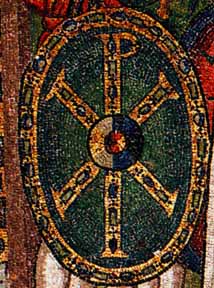
The “X” in Xmas is not an invention of Hollywood, McDonald’s or Wal*Mart, but is in fact the Greek letter chi, the first letter in the Greek “christos”, Jesus’ title. Rudolph may have been a department-store marketing scheme, but the X is hard-core.

X as shorthand for “Christ” has a long history. For xample, at the battle of the Milvian bridge in 312 A.D., legend has it that the Emperor Constantine saw a floating mystical “chi-rho” (XP) symbol in the heavens, a portent of victory if he accepted Christianity. He ordered his soldiers to put the symbol on their shields. This was, you will note, far before the age of crappy American nu-skool spellings like “donut” and “dri-kleen”. This is about as old-school as an abbreviation can get.

This whole issue clears up a poorly researched and utterly useless factoid I read and memorized as a child in, I believe, The Book of Lists. For some reason I more or less memorized this book as a kid, although I now realize that it wasn’t as dependable as its all-list format made it seem. It was kind of like the Guinness Book of Records in that way; you knew it was sheer raving madness but the statistics-based format lent it some kind of believability. Kids are suckers for that combination of freak show and official list. I remember staring at that picture of the man with the record for longest fingernails for hours. But fingernails are at least theoretically measureable. Why was the guy with the beard of bees in the record book? What measurement did they use to calculate the record-breaking nature of his beard of bees? I call shenanigans.

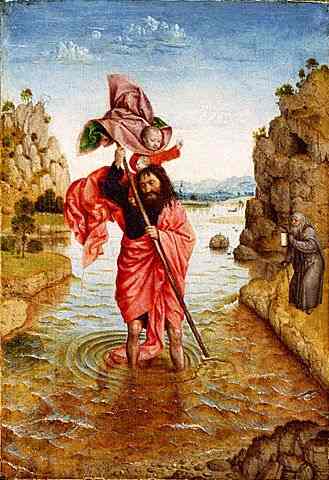
Anyway, the factoid which I think was from The Book of Lists was: “Christopher Columbus always signed his name ‘Xpo Ferens’. Nobody knows why.” I barely know the rudiments of Greek or Latin, but it’s blindingly clear to me why – why nobody involved in compiling that book had half a brain cell is the true mystery. I guess this was before the Internet, when it was easy for people to propagate urban legends and claim that things were mysterious when they were really nothing of the sort. “Xpo Ferens” is just a slightly strange way of writing “Christopher”. “Xpo” is short for Greek “Christo”, which looks like “Xpisto” in Latin characters, and “ferens” is Latin for “bearing”. Christopher means Christ-bearer or Christ-ferry, as everyone who’s seen a painting of Saint Christopher must know. He was basically a kind of Blaster to Jesus’s Master, a mythical giant who carried baby Jesus across a stream, which is why he’s no longer really a saint and was dropped from the calendar. You almost expect Baby Jesus to screech, “Who rule Bartertown?” At least I do.

Anyway, my point was that if you want to say or write “Xmas”, feel free. You’ll be using an ancient Greek letter, not being cheap and commercial. Merry Xmas.

p.s. This post is dedicated to my dad, whose birthday is coming up on the 8th and who spent a lot of time and effort devising well-researched and historically inquisitive Sunday School lessons in a similar vein when we were kids. I might not be as religious as he is, but I think we both appreciate the history of religion in a similar way.

Thursday, November 30, 2006

Cribs: Mongolian Edition

Since winter is approaching and it’s difficult to get in a wintry mood here in Kuala Lumpur, I’ve taken to looking for the most desolate and godforsaken frigid wastelands I can find on Google Earth, to get me in the holiday mood. I’ve been checking out fjords and icebergs and the Faroe Islands and so on.

I recommend the area around the Kamchatka Peninsula for a true scene of bitter, soul-crushing emptiness – I can’t really tell but I imagine most of what I see is fishing villages, oil outposts and Soviet military bases. So I assume everyone there probably looks a lot like Santa, except with fewer sleighbells, toys and jollity, and more vodka, knife fights and Russian Roulette.

So let’s take a little gander at a place I assume is pretty cold and desolate, Ulaan Baatar, Mongolia. I don’t remember the name having those extra “a”s when I was a kid. Maybe the city’s growing. I can only hope I live long enough to see them add a third and possibly even fourth “a” into the mix.

Here’s the city. Looks small and dusty, but presentable. There’s a big central square, a soccer field, and what looks like residential sprawl on the hills around it. Much less exotic than I was expecting. Maybe a closer look will show some local color.


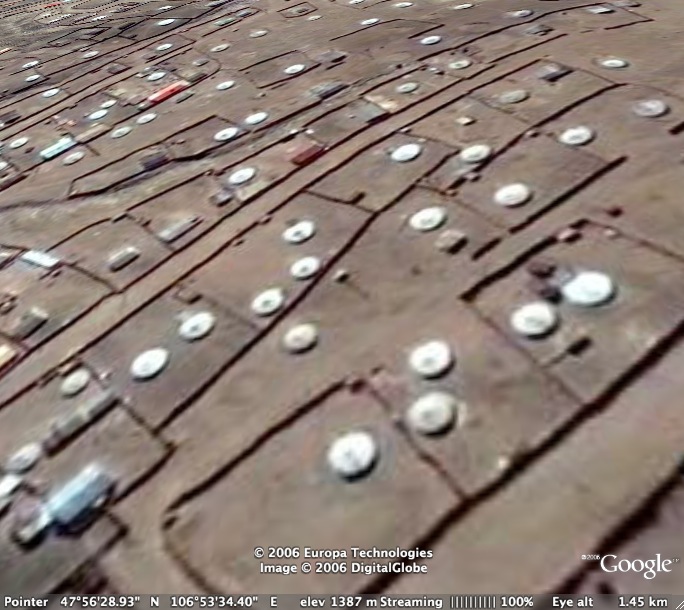
Let’s zoom in on those hillside residences, shall we? Take a gander at how Ulaan Bataar’s middle class like to set up their cribs, just a few hundred yards from the bustling capital’s heart. Oh dear. Those aren’t... They can’t be...


They are. Tents.


Everyone apparently lays out a nice little yard with a big stone wall around it, and then sets up their yurt. Er, hello, Mongolians? Far be it from me to tell you how to live your lives but dudes if you’ve got the massive shipments of bricks and mortar for those sturdy fences you know what else you can do with them? BUILD A F&#KING HOUSE. Oh well. Sarcasm and cultural insensitivity aside, it’s pretty cool that they still live in those tents, even just outside the dead center of the capital city. ’Cause that’s how they roll. That’s probably what suburban Chicago would look like today, if we hadn’t kicked out all the Indians. Except with teepees, of course.

Here is a picture I just found of what those white circles in the Google Earth pictures must be. As I suspected, yurts, yurts and more yurts. Yurtles all the way down. Note that it clearly has a concrete foundation. Oh you wacky Mongolians.

Friday, November 24, 2006

Al O’Limerick


Wherein I try my hand, not once but frice... er, force?... four times, at an auncient Irish verse form as time-honoured and venerable as the beloved Shamrock Shake:

1. The Moistened Pedagogue
Malaysia: a substitute teacher
had sweat as a notable feature.
He sweated all day
tried to wipe it away
Others said, “what a damp, smelly creature.”

2. Customs Officials
or
Sure, Use Up an Entire Page of My Passport for One Stamp, You Stamp-Happy Ass

When traveling in Indonesia
The visa fee might well displease you
It’s thirty-five bucks
yet the government sucks…
Where’s that money go after they squeeze you?

3. Formatting Fatigue
I find it a tedious trial
to write things in APA style.
I forgot to indent
and down my grade went
I’ll be angry about it a while.

4. Bistromath
When having a restaurant luncheon
The math at the end doesn’t function.
When your friends add their share
the result’s far from fair
And you stifle the impulse to punch ‘em.

Monday, November 20, 2006

the courage to hate the olympics

I’m a vigorous, lusty man of grandiose gestures and consuming passions, and I live life to the fullest. Sometimes I sit for long periods of time, and – this is where it starts to get tricky; don’t try this at home – sometimes I lie down for long periods of time. As if that weren’t enough, sometimes I even play video games while sitting or lying down. One of my many extreme sports hobbies is interactive fiction.

Interactive fiction is basically just a fancy term for text-based computer games. They were popular in the 1980s. The most well-known game series was called Zork. I always liked these games because, like reading a book, they allow you to use your own imagination to picture what’s going on. Only within the last couple of years have video games started to have good enough graphics to compete with the mental pictures I used to draw when I played text adventures. Anyway, I’m still quite interested in the genre and often re-play old games or try some of the new homemade games being created by enthusiasts. I even programmed a very short game myself in Inform 6 for a grad school project this summer.

Anyway, while I was looking around at online interactive fiction resources the other day, I came across the writings of a text game author, a Mr. Stephen Bond, and to my surprise found that there is actually someone who’s more critical than I am. This guy hates the Olympics. That takes a certain pessimistic genius, and my hat’s off to him. I can’t argue with him, either – The Olympics do pretty much suck; I just never would have dared to take such a bold ideological stance on my own. I have no point here except that I wanted to give him a shout-out for providing me with some funny and thought-provoking reading material. Here’s an excerpt from a post I particularly liked, called “how to recognise people who try to command, control and influence people”:

The Only One in Control
The schemer must always appear in control of the situation, even when the situation does not require control of any kind. In fact, schemers usually lose control of things in a real crisis, but that is beside the point. One way in which the schemer maintains the appearance of control is by making out that the surrounding people are losing it.

For example, a schemer may tell someone to ‘take it easy’, even when that person is taking it easy, or say ‘Relax, we have plenty of time,’ even when the other person is relaxing and is well aware that there is plenty of time. Other typical phrases are ‘It's important that we maintain a sense of focus here,’ and ‘Let's keep our minds on the task at hand.’

Hypnosis
Schemers believe that they can bend other people’s wills by the power of mind alone. They are often seen attempting a form of hypnosis, which involves staring at someone in the eyes, addressing them by their first name, and telling them to do something.

“Tony, you'll do that for me, won’t you.”

The hypnotism attempt is sometimes accompanied by a pat on the back or some other physical contact. If the victim is demoralised enough, the hypnosis will actually work.

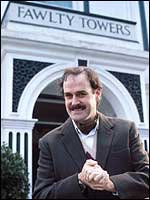
The Fawlty Tow’r

Why does everyone who wants to force themselves into a prefabricated poetic form have to write haikus all the time? Screw haikus.

Why not try to funnel our poetic juices into another juice box, as it were? I choose to let the capricious sun of inspiration play a high C until I live to be 100 Plus. Tetra Pak. NO MORE JUICE BOXES, CHLOE.

Crap. I’ll start again.

One of the many books I’ve started but not finished is The Faerie Queene by Edmund Spenser.

One of the many reasons that I haven’t finished reading this book is the strange and extremely restricting meter in which the poem was written. It has to be one of the most convoluted ways to write a poem I’ve seen. Here’s my first and so far only shot at a single stanza of Spenserian metre. Now keep in mind that old Spenser wrote about a jillion stanzas using the exact same rhyme scheme. No wonder his epic poem doesn’t make any damn sense. Anyway, here’s my one stanza. It’s a true story of a 21st-century manchild and his quasi-legal downloading:

Tonight I sought to burn a DVD
Containing episodes of Fawlty Tow’rs.
But what should I upon exam’ning see?
The disc could hold but one and one-half hours!
I’d thought these discs possess’d quite greater pow’rs.
Three episodes at most a disc would fit!
Thus my enthusiasm for it sours.
Now on my hard drive those old shows will sit;
I watch the tiny screen and feel an utter twit.

Monday, November 13, 2006

The Ruiner’s Lament

Kim calls me a “ruiner” because I’m so critical of everything. And because I’m often quite crotchety. And because I’m prone to believing critical movie and book reviews, even if the reviews are clearly written by blithering idiots. And because I’m prone to telling her what she feels are crucial details about the endings to things before she’s seen them. Hm... now that I think about it I suppose there might be a teeny tiny speck of justification for the title of ruiner. I certainly believe in preemptively detesting everything and everyone until I see clear and incontrovertible evidence of nonsuckiness.

Well, the spoiler has been bespoiled. I’ve been hoist on my own petard. A petard is a type of bomb named after “a loud discharge of intestinal gas,” by the way. Just because something’s in Hamlet doesn’t mean it’s not naughty.

Anyway, I’ve gone and done ruined something for myself, and that something is several of my very favorite poems, including the well-known “The Lake Isle of Innisfree” by Yeats and “Skunk Hour” by Robert Lowell. I do not claim to have particularly refined or obscure taste in poetry; both of these are over-anthologized poems which most students are made to study at some point. I know I saw both of them ad nauseam in both high school and college, and strangely they never got old and I liked both very much indeed. Then came The Spoilening.

I recently acquired a copy of what Amazon calls In Their Own Voices: A Century of Recorded Poet [BOX SET] (I guess they’ve still got some kinks to work out of their titling system). It’s just what it sounds like, a set of recordings of poets reading their own work. The first one is Walt Whitman, apparently recorded on the very first record player Thomas Edison ever built – you know, the one made out of granite and powered by human blood. It’s an interesting and valuable piece of history, and a priceless record of one of America’s greatest poets.

Now future generations will know that Walt Whitman sounded like a big women’s blouse. (If you have Windows Media Player or RealPlayer, check out the samples on the Amazon page and see hear for yourself. I’m currently using a Mac and I vowed never to install RealPlayer again many years ago because of the stupid ads and extra programs they keep trying to rope you into, so I can’t vouch for whether or not the samples prove my point, but I’ll pretend they do.) I don’t know if it was the recording, or if old Walt was 90 when they recorded him, or if he just sounded kind of silly when he talked, but he has kind of an Elmer Fudd/Woody Allen voice. The line of powerful and stirring adjectives “Strong, ample, fair, enduring” from the poem, when read by its creator, sounds like “Steh-wroang, eaample, faiah, endoooring”. It sounds a lot less like a rousing ode to a great nation by a master poet and a lot more like Linda Richman from Coffee Talk getting verklemmt.

This, sadly, was not the most disillusioning of my discoveries. For whatever reason Whitman sounded kind of wimpy, but Yeats, doing “The Lake Isle of Innisfree”, has an entirely different problem.

In case you’re not familiar with it, “The Lake Isle of Innisfree” is the most peaceful and meditative poem about harmony with the natural world ever written by a non-Japanese person. It’s about having a calm quiet place to think about, about calmly hearing the sound of water lapping on the shores, even when you’re in the grey city. It’s lovely and very, very peaceful and soothing.

The problem is that when Yeats, the author of this pleasant, soothing poem, reads it himself he bellows it out as if it’s Judgment Day. He has a booming “Grrreat Poetick RRRRECITATION!” voice that sounds as if he’s Moses reading the Commandments off the stone tablets. He sounds like Saruman on his little oration balcony at Isengard getting the Uruk-Hai really whipped up before they go and pillage something. Which would be great for many of Yeats’ poems, “The Second Coming”, for example, but which is just really, really crappy for “Innisfree”.

It’s such a soothing poem when I read it on the page. “And I shall have some peace there, for peace comes dropping slow…” But when Yeats reads it, it’s like he’s just getting to the last line of a campfire story about hobgoblins and banshees: “FeRRRR PEACE… comes DRRRRRROPPING slO-O-O-O-O!” I understand that he came from an earlier time, when poets probably all had a sort of powerful Master Thespian declaiming voice they used, but now when I think of the poem, or even just see the words on a page, I think of that old man’s furious growling voice. It’s exactly like sitting down for a session of Zen meditation and hearing Gandalf hollering “YOU. SHALL. NOT. PASS!” every time you close your eyes. It’s just ruined it.

I won’t even go into what I think of Robert Lowell’s nutball voice. Let’s just say I liked “Skunk Hour” a lot more when I didn’t have the unforgettable mental image of it being read aloud by an effeminate Mayor Quimby.

Wallace Stevens on the other hand didn’t ruin his poem at all. I pretty much would have figured he had a silly voice – I mean, when you name a poem “The Emperor of Ice-Cream” and include the lines “bid him whip/
In kitchen cups concupiscent curds,” you’re setting a certain circus-tent vibe from the get-go. So he’s fine in my book.

And then there’s Ezra Pound. That enormous poseur. Tell me if you hear this, but I could swear that he’s exactly copying Yeats’ “Grrreat Poetick RRRRECITATION!” voice and rhythm. Maybe young Idahoans back then sounded exactly like elderly Irishmen, I don’t know, but it definitely seems suspicious.

Ruined. All ruined. Damn you, today’s modern multimedia world of the future! Damn you to Hell, sir! Now I’m wondering what else I like in written form that would suck if I heard it aloud by the author. Maybe Dante sounded like Bobcat Goldthwaite. Maybe Abraham Lincoln sounded like Rosie O’Donnell. ARGH.

Now, I know I have been harsh on these poets’ voices, but I’m not saying that I would sound any better if I read poetry aloud. Au contraire, mon frère. On the few occasions when I’ve heard my own voice on the answering machine, I’ve been filled with an urge to punch myself in the head so that no one would ever have to hear that awful voice again. I’m just saying that I’ve discovered that some poetry is MUCH, MUCH better when left on the page. Again, I urge you to listen to the samples yourself and let me know if you agree.

In any case, I will never hear those poems the same way again. And thus, faire Reader, was the Naturall Order turn’d upon its Arse, and the Ruiner him Self Ruin’d.

Tuesday, November 07, 2006

Shantih Shantih Sieg Heil

I’ve already done a post about something I saw on Bali that combined European culture, modern Asia and Sanskrit word origins (chess). Oddly, that was merely the second most mind-blowing thing I witnessed on that trip which combined those exact same fields of interest. If you are someone who does not already know Sanskrit but who happens to be as interested in connections between far-flung words as I am, prepare to be thunderstruck. Both of you.

As we were being shamanistically blessed by a woman along the side of the road (it was the van driver’s idea, and is a good example of why a trip to Bali does have redeeming features, despite what my lovely wife might say), she came up to my window (the Balinese witch doctrix, not Kim), smeared some grains of rice on my forehead, and reverently said to me: “Om Swasti asti blabitty blah blah blah…”. There was a lot more to the blessing than that, but who cares.

I knew the old Hakenkreuz was an ancient religious symbol – but I didn’t know that the exact same word more or less was still a friendly everyday greeting on Bali. What the heck? Then it hit me – and this is the moment of utter jaw-dropping etymological pyrotechnics – if “swasti(ka)” is some sort of cheery salutation then maybe, I thought, it’s the same thing as hello in Thai; “sawadee ka”.

It was like the globe had just twisted into a Klein bottle. Nazi soldiers and Thai monks went around saying the exact same word several times a day? That’s insane. That’s like learning that “colostomy bag” means the same thing as “fuzzy bunny”. A similar revelation which blew my mind back in the day was that “Aryan” and “Iran” are more or less the same word, but this swastika thing stretched even further across the globe, and was even more bizarre.

I haven’t actually found that much direct information yet about the connection between swastika and sawadee ka. If you happen to know anything on the subject let me know. Maybe the “ka” suffix part is just a coincidence and only swasti is really a leftover from Sanskrit, I dunno.

Friday, November 03, 2006

Sam Sees an Oliphaunt

In Bali recently I saw dozens of pairs of people sitting on the sidewalks in front of their souvenir stores and playing chess. I thought that this was really neat. I assume that the trend got started because among the souvenirs that the Balinese mass-produce are wooden chess sets, but even so there was something fascinating about seeing non-Westerners playing chess for fun. I suppose I’ve got a stereotype of chess as a highly refined and intellectual European pursuit, to be carried out in utter silence by perspiring Slavs or Icelanders with rumpled suits and enormous egg-like craniums. Seeing this reminder that this was just a stereotype and that it’s a fun game for just about anyone was quite inspiring. I’m trying to brush up on my chess skills. It is, however, difficult to polish a turd. I’m horrible at chess. It requires long-range strategic thinking which, as Kim knows from when we’re planning vacations years in advance, is difficult for me. But anyway, I’m working on it.

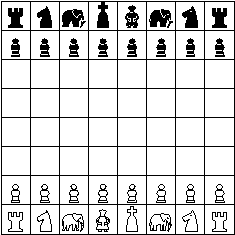
So anyhoo, a little internet research on the history of chess and what do I find but something INCREDIBLY INTERESTING. At least to me. The bishops are supposed to be elephants!

From this website on the Indian game which is apparently the direct ancestor of our chess set:

The pieces were raja (king), mantri (counsellor, ancestor of the ferz), gaja (elephant, later called fil), asva (horse), ratha (chariot, later called rook), and pedati (infantry or pawns).

The elephants/bishops used to move a little differently; if you have Java working properly you can play the old version here.

Not only is that little historical background into the pieces interesting in itself, but those Sanskrit or whatever names of the pieces are quite meaningful too. “Raja”, “Mantri” and “Gaja” are all still Malay words, and “Ratha” and “Pedati” really show their indo-european origins. We also used to eat at an Indian restaurant in Munich called Radha which I believe was supposed to mean “chariot”. As if that weren’t enough, “Mantri” a.k.a. Menteri or minister in Malay is supposedly the origin of the word “Mandarin”.

Overall I think I like chess better now that I know the pieces are all supposed to represent actual military field units and not some weird lathe-turned royal family out on a pleasant stroll with their favorite priests and a couple of self-propelled castle towers. Au contraire! Chess is the prequel to Advance Wars.