Friday, September 29, 2006

I don’t think you win a Pulitzer...

...for filth. Just a quick note to say that after recent, exhaustive and still-ongoing research I like both versions of “The Office” exactly, precisely equally. Both shows are really, really funny. The British one is almost too melancholy to bear, which I love, and the American one is slightly more upbeat and a bit closer to my own working experience, which I also love.

The UK one only went on for 14 episodes or so, so it didn’t have a chance to get stale, while the US one has had more time to develop the supporting characters. So... it’s a tie. This is all only really noteworthy because I would have expected not to like the American one, since it’s a copy and since I have always had a sort of embarrassing knee-jerk Anglophilia – but they have done a really good job and the cast is perfect. I honestly couldn’t pick a favourite/favorite if I had to.

The verdict is still out on “Le Bureau” until I can download at least one episode. My hunch is that it sucks. Colossally.

Tuesday, September 26, 2006

what the hell are we doing?

Pfc. Hannah L. McKinney
Hometown: Redlands, California, U.S.

Age: 20 years old

Died: September 4, 2006 in Operation Iraqi Freedom.

Unit: Army, 542nd Maintenance Company, 44th Corps Support Battalion, Fort Lewis, Wash.

Incident: Died from injuries suffered when she was struck by a vehicle in Taji.


Sgt. Adam L. Knox
Hometown: Columbus, Ohio, U.S.

Age: 21 years old

Died: September 17, 2006 in Operation Iraqi Freedom.

Unit: Army Reserves, 346th Psychological Operations Company, U.S. Army Reserve, Columbus, Ohio

Incident: Killed when his patrol encountered enemy forces using small arms fire during combat operations in Baghdad.


Pfc. James J. Arellano
Hometown: Cheyenne, Wyoming, U.S.

Age: 19 years old

Died: August 17, 2006 in Operation Iraqi Freedom.

Unit: Army, 1st Battalion, 67th Armored Regiment, 2nd Brigade, 4th Infantry Division, Fort Hood, Tex.

Incident: Killed when his patrol encountered enemy forces using makeshift bombs and small arms fire in Baghdad.


* * *

Now that you've met these three peppy young kids, why not take a few minutes to get acquainted with their 3,006 buddies?

I am usually not very political, and it unfortunately often takes a graphic representation like the above site to make me really think about what is going on. I won’t make any further comment except to say that we all - those of us who are Americans - share responsibility for these young people’s deaths. Some more than others.

Sunday, September 24, 2006

fourteen signs you are a fascist: THE PREQUEL

My lovely and talented wife recently posted a list of 14 tell-tale characteristics of fascist states – the majority of which are disturbingly applicable to the current presidential administration. I found it quite interesting and thought-provoking, as I do every post on her blog, Follow That Elephant!

However, as usual I couldn’t just leave it at that. I agreed with the article Kim posted but it also provoked my curiosity. Whence had this list come? I am a very skeptical person and, as Kim can testify, I like to try to investigate the original source of things that get spread around the Internet. I wondered if the fascism article might be an urban legend type e-mail forward with no official source behind it, like the one about the Koran, Verse 9:11 or the Julius Caesar quote which was suspiciously anti-Bush. I snooped and snopesed around a bit.

It was an actual article, although the author is not in fact a doctor of political science (as all the versions I have seen claim) but a retired Xerox divisional vice president.
But never mind that. My purpose here is not to pick apart the article or its author. For one thing, as far as I’m concerned, the more people willing to make comparisons between the Bush administration and other misbehaving governments throughout history, the better. Good for him. What I want to do here is share another interesting article I came across during my search.

Apparently, the idea of writing an essay containing fourteen points which define fascism was invented way back in 1995 by none other than one of my very very favorite friggin authors of all time, Umberto Eco. Not that it matters because their content is so different, but our ex-Xerox employee seems to have... er... duplicated... the earlier article’s format.

Why fourteen? Not sure, but whatever the reason the article title shows just why I friggin love Eco so much – it’s a reference to a famous Wallace Stevens poem, possibly my favorite Stevens poem of all. Note the poem’s two references to Connecticut. Anyway yes the ‘14 ways...’ title is just a lame pun but it’s what I live for. Seeing such an electrifying link between my favorite Hartford-dwelling poet and my favorite Milanese intellectual is the sort of thing that fills me with joy. By the way, Stevens was an executive at an insurance company as well as a good poet, so there’s no reason a Xerox vice president can’t be a political commentator. I shouldn’t have been so snide above. Holding down a 9-to-5 or wearing a tie or even being a vice-president of something says little about a person’s inner life.

Anyway, poetic references aside, Eco’s earlier article is a little less obviously applicable to the current administration, but I feel it’s more thought-provoking. While the more recent list concentrates on surface manifestations of what the author deemed fascism, Eco’s original article tried to get to the dark heart of the fascist mentality – its (very successful) tactics of appealing to the reactionary, the primal, the primitive, the xenophobic. I think as many or more of Eco’s points can be applied to militant Islamist attitudes as could be applied to Bush. And so in this disturbing context I present to you the (as far as I know) original text of Eco’s article. Oddly, I couldn’t find this essay anywhere in Italian. Maybe he specifically wrote it for an English publisher. Or maybe I just didn’t look hard enough. I’d be curious to see an Italian version, if anyone can find it. Enjoy the article, and note the disturbing fact that the language of Eco’s anti-fascist conclusion, almost word-for-word, has been twisted toward ur-fascist ends in the last few years. Yikes. And so without further adieu I present:

Eternal Fascism:
Fourteen Ways of Looking at a Blackshirt

By Umberto Eco


Writing in New York Review of Books, 22 June 1995, pp.12-15. Excerpted in Utne Reader, November-December 1995, pp. 57-59.
The following version follows the text and formatting of the Utne Reader article, and in addition, makes the first sentence of each numbered point a statement in bold type. Italics are in the original.
For the full article, consult the New York Review of Books or purchase Eco’s new collection of essays: Five Moral Pieces.

In spite of some fuzziness regarding the difference between various historical forms of fascism, I think it is possible to outline a list of features that are typical of what I would like to call Ur-Fascism, or Eternal Fascism. These features cannot be organized into a system; many of them contradict each other, and are also typical of other kinds of despotism or fanaticism. But it is enough that one of them be present to allow fascism to coagulate around it.

1. The first feature of Ur-Fascism is the cult of tradition.
Traditionalism is of course much older than fascism. Not only was it typical of counterrevolutionary Catholic thought after the French revolution, but is was born in the late Hellenistic era, as a reaction to classical Greek rationalism. In the Mediterranean basin, people of different religions (most of the faiths indulgently accepted by the Roman pantheon) started dreaming of a revelation received at the dawn of human history. This revelation, according to the traditionalist mystique, had remained for a long time concealed under the veil of forgotten languages – in Egyptian hieroglyphs, in the Celtic runes, in the scrolls of the little-known religions of Asia.

This new culture had to be syncretistic. Syncretism is not only, as the dictionary says, “the combination of different forms of belief or practice;” such a combination must tolerate contradictions. Each of the original messages contains a sliver of wisdom, and although they seem to say different or incompatible things, they all are nevertheless alluding, allegorically, to the same primeval truth.

As a consequence, there can be no advancement of learning. Truth already has been spelled out once and for all, and we can only keep interpreting its obscure message.

If you browse in the shelves that, in American bookstores, are labeled New Age, you can find there even Saint Augustine, who, as far as I know, was not a fascist. But combining Saint Augustine and Stonehenge – that is a symptom of Ur-Fascism.

2. Traditionalism implies the rejection of modernism.
Both Fascists and Nazis worshipped technology, while traditionalist thinkers usually reject it as a negation of traditional spiritual values. However, even though Nazism was proud of its industrial achievements, its praise of modernism was only the surface of an ideology based upon blood and earth (Blut und Boden). The rejection of the modern world was disguised as a rebuttal of the capitalistic way of life. The Enlightenment, the Age of Reason, is seen as the beginning of modern depravity. In this sense Ur-Fascism can be defined as irrationalism.

3. Irrationalism also depends on the cult of action for action’s sake.
Action being beautiful in itself, it must be taken before, or without, reflection. Thinking is a form of emasculation. Therefore culture is suspect insofar as it is identified with critical attitudes. Distrust of the intellectual world has always been a symptom of Ur-Fascism, from Hermann Goering’s fondness for a phrase from a Hanns Johst play (“When I hear the word ‘culture’ I reach for my gun”) to the frequent use of such expressions as “degenerate intellectuals,” “eggheads,” “effete snobs,” and “universities are nests of reds.” The official Fascist intellectuals were mainly engaged in attacking modern culture and the liberal intelligentsia for having betrayed traditional values.

4. The critical spirit makes distinctions, and to distinguish is a sign of modernism.
In modern culture the scientific community praises disagreement as a way to improve knowledge. For Ur-Fascism, disagreement is treason.

5. Besides, disagreement is a sign of diversity.
Ur-Fascism grows up and seeks consensus by exploiting and exacerbating the natural fear of difference. The first appeal of a fascist or prematurely fascist movement is an appeal against the intruders. Thus Ur-Fascism is racist by definition.

6. Ur-Fascism derives from individual or social frustration.
That is why one of the most typical features of the historical fascism was the appeal to a frustrated middle class, a class suffering from an economic crisis or feelings of political humiliation, and frightened by the pressure of lower social groups. In our time, when the old “proletarians” are becoming petty bourgeois (and the lumpen are largely excluded from the political scene), the fascism of tomorrow will find its audience in this new majority.

7. To people who feel deprived of a clear social identity, Ur-Fascism says that their only privilege is the most common one, to be born in the same country.
This is the origin of nationalism. Besides, the only ones who can provide an identity to the nation are its enemies. Thus at the root of the Ur-Fascist psychology there is the obsession with a plot, possibly an international one. The followers must feel besieged. The easiest way to solve the plot is the appeal to xenophobia. But the plot must also come from the inside: Jews are usually the best target because they have the advantage of being at the same time inside and outside. In the United States, a prominent instance of the plot obsession is to be found in Pat Robertson’s The New World Order, but, as we have recently seen, there are many others.

8. The followers must feel humiliated by the ostentatious wealth and force of their enemies.
When I was a boy I was taught to think of Englishmen as the five-meal people. They ate more frequently than the poor but sober Italians. Jews are rich and help each other through a secret web of mutual assistance. However, the followers of Ur-Fascism must also be convinced that they can overwhelm the enemies. Thus, by a continuous shifting of rhetorical focus, the enemies are at the same time too strong and too weak. Fascist governments are condemned to lose wars because they are constitutionally incapable of objectively evaluating the force of the enemy.

9. For Ur-Fascism there is no struggle for life but, rather, life is lived for struggle.
Thus pacifism is trafficking with the enemy. It is bad because life is permanent warfare. This, however, brings about an Armageddon complex. Since enemies have to be defeated, there must be a final battle, after which the movement will have control of the world. But such “final solutions” implies a further era of peace, a Golden Age, which contradicts the principle of permanent war. No fascist leader has ever succeeded in solving this predicament.

10. Elitism is a typical aspect of any reactionary ideology, insofar as it is fundamentally aristocratic, and aristocratic and militaristic elitism cruelly implies contempt for the weak.
Ur-Fascism can only advocate a popular elitism. Every citizen belongs to the best people in the world, the members or the party are the best among the citizens, every citizen can (or ought to) become a member of the party. But there cannot be patricians without plebeians. In fact, the Leader, knowing that his power was not delegated to him democratically but was conquered by force, also knows that his force is based upon the weakness of the masses; they are so weak as to need and deserve a ruler.

11. In such a perspective everybody is educated to become a hero.
In every mythology the hero is an exceptional being, but in Ur-Fascist ideology heroism is the norm. This cult of heroism is strictly linked with the cult of death. It is not by chance that a motto of the Spanish Falangists was Viva la Muerte (“Long Live Death!”). In nonfascist societies, the lay public is told that death is unpleasant but must be faced with dignity; believers are told that it is the painful way to reach a supernatural happiness. By contrast, the Ur-Fascist hero craves heroic death, advertised as the best reward for a heroic life. The Ur-Fascist hero is impatient to die. In his impatience, he more frequently sends other people to death.

12. Since both permanent war and heroism are difficult games to play, the Ur-Fascist transfers his will to power to sexual matters.
This is the origin of machismo (which implies both disdain for women and intolerance and condemnation of nonstandard sexual habits, from chastity to homosexuality). Since even sex is a difficult game to play, the Ur-Fascist hero tends to play with weapons – doing so becomes an ersatz phallic exercise.

13. Ur-Fascism is based upon a selective populism, a qualitative populism, one might say.
In a democracy, the citizens have individual rights, but the citizens in their entirety have a political impact only from a quantitative point of view – one follows the decisions of the majority. For Ur-Fascism, however, individuals as individuals have no rights, and the People is conceived as a quality, a monolithic entity expressing the Common Will. Since no large quantity of human beings can have a common will, the Leader pretends to be their interpreter. Having lost their power of delegation, citizens do not act; they are only called on to play the role of the People. Thus the People is only a theatrical fiction. There is in our future a TV or Internet populism, in which the emotional response of a selected group of citizens can be presented and accepted as the Voice of the People.

Because of its qualitative populism, Ur-Fascism must be against “rotten” parliamentary governments. Wherever a politician casts doubt on the legitimacy of a parliament because it no longer represents the Voice of the People, we can smell Ur-Fascism.

14. Ur-Fascism speaks Newspeak.
Newspeak was invented by Orwell, in Nineteen Eighty-Four, as the official language of what he called Ingsoc, English Socialism. But elements of Ur-Fascism are common to different forms of dictatorship. All the Nazi or Fascist schoolbooks made use of an impoverished vocabulary, and an elementary syntax, in order to limit the instruments for complex and critical reasoning. But we must be ready to identify other kinds of Newspeak, even if they take the apparently innocent form of a popular talk show.

Ur-Fascism is still around us, sometimes in plainclothes. It would be so much easier for us if there appeared on the world scene somebody saying, “I want to reopen Auschwitz, I want the Blackshirts to parade again in the Italian squares.” Life is not that simple. Ur-Fascism can come back under the most innocent of disguises. Our duty is to uncover it and to point our finger at any of its new instances — every day, in every part of the world. Franklin Roosevelt’s words of November 4, 1938, are worth recalling: “If American democracy ceases to move forward as a living force, seeking day and night by peaceful means to better the lot of our citizens, fascism will grow in strength in our land.” Freedom and liberation are an unending task.

Umberto Eco (c) 1995

Thursday, September 21, 2006

Father, if thou be willing, remove this sippy cup from me

This SIP thing is probably old news to all you adept cybernauts, but – hey by the way, ‘cybernaut’ is by a weird coincidence identical to a very, very old word; kybernitis was the Greek word for a ship’s captain. “kyber” or “cyber” meant to steer, and so… oh dear. I’ll start again.

SIPs or Statistically Improbable Phrases are apparently what Amazon calls strange combinations of words which it finds after number crunching a book. I call it just about the stupidest idea I have ever heard of, and I hope the idiots who wasted their time and Amazon’s money programming this function have been appropriately punished. But I thought I would investigate the thing nevertheless.

To my surprise some of the results did seem to sort of reflect the spirit of their parent books, in an odd way. So here are some of the glorious, unforgettable phrases which make these great works of literature tower so loftily above the clotted, fetid detritus of normal human output. To add to the challenge I will try to limit myself to one epitomizing SIP per book, all from Amazon’s normal listings.

The Sound and the Fury: dis mawnin

Of Mice and Men: stable buck

Ulysses: seaside girls

Kafka’s Collected Stories: felt gag

Bleak House: spontaneous combustion (?)

Jurassic Park: soft hooting cry

Lord Jim: honourable sir

Shogun: fresh kimono

Infinite Jest: feral hamsters

Gravity’s Rainbow: pig mask

And, of course, the entire text of Finnegans Wake.

So there you have it. That is why those guys get the big bucks. Their unique ability to paint their literary canvases with evocative phrases such as “soft hooting cry” and “pig mask”. Actually I really like pig mask. Somehow it sums it all up for me.

Tuesday, September 19, 2006

where’s my exosuit when i need it?

I love living in Malaysia, but I can not understand how people drive here.

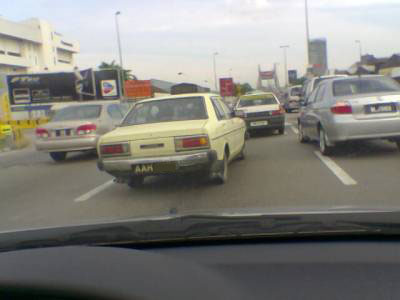
I mean that two ways: a) I can’t understand how they actually physically perform the batsh*t loony toons insane manoeuvers they squeal and wrench and swerve their Proton POSes into, and b) I can’t comprehend how human beings can agree as a society that this is how motor vehicles should be driven.

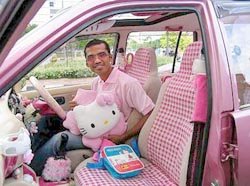
I will say up front that we often ride in taxis, and taxi drivers in any country usually have whimsical little ways of making the drive fun for themselves, usually by treating the gas and brake like kick drum pedals, but this goes beyond the norm and a lot of this applies to our experience driving in normal peoples’ cars, too. This is an eleven-point breakdown of how our typical Malaysian road experience will go:

1. We stand on the side of the road for about a minute waiting for a taxi, choking and gasping in the noxious fumes as an endless convoy of cement trucks and work vans and other behemoths go rumbling thunderously by at about one mile an hour. I’m exaggerating the number of cement trucks – occasionally there will be a car, a motorcycle or a fat European in an SUV.

2. One of us makes an infinitesimal waving gesture towards a taxi hundreds of yards away, which a split second later swerves wildly to the side of the road and waits for us, causing everyone else on both sides of the street to have to swerve around him.

3. We dash across the street to the taxi, narrowly escaping being flattened by the caravan of roaring cement trucks.

4. The second we close the door the taxi driver swerves violently back into traffic, does a screeching u-turn with his eyes shut tight and speeds off, cutting off anyone who might have happened to be going in either direction during this process, and somehow narrowly avoiding the five other taxis who are doing the same thing at the same time.

5. We tear ass along the highway at speeds only limited by the facts that the car is a hunk of junk and that every single other motorist in front of us is trying to occupy at least two lanes via aggressive swerving and weaving tactics.

6. Our taxi driver attempts to counter this by swerving even more wildly, driving in between other cars, running motorcyclists off the shoulder, and riding people’s bumpers.

7. We almost die in horrible accidents about six to eight times, each time missing death by mere inches. At no point does anyone involved look in any of their mirrors or turn their head in any direction at all. Ever.

8. I begin to get nauseous. The keening Indian music on the radio, which seemed cute when we got in the taxi, now seems like the earsplitting death throes of a legion of demonic banshees. I pray for a swift death.

9. For a brief, surreal moment, the swerving stops and all is utterly still as the taxi driver hands over some toll money. Then we’re off and swerving again.

10. We almost die a further three to five times.

11. We reach our destination, toss some money at the cab driver, and stagger unsteadily out into the sane world, shocked to have survived the Auto Apocalypse once again.

The Malaysian government is apparently aware of the problem and are working on it through psy-ops because we are subjected to horrifying, maudlin TV commercials which are of the same genre as the old driver’s ed. standbys such as “Blood on the Dashboard”. There is even some sort of government website where you’re encouraged to post pictures of offensive drivers or something. I will leave you with this quote from one of that site’s forums, which I think puts the Malaysian pedestrian’s suicidal dilemma nicely and also, I think, captures some of the adorable, quirky style of Malaysian English:

It is sad to say Malaysian motorists will never respect pedestrian and zebra crossing. Try crossing them when pedestrian light is still blinking. The main culprits are the motorcyclists. They will zoom past you in every nooks and corner in a threatening manner as though as you are not existing, and continuously honking at you. Say me bad or whatever without sympathetic heart...if they were knock down by other vehicles, they deserve it.

Vehicles are no better. They just stop right on top of the pedestrian/zebra crossing while waiting for the green light to turn.

When Malaysian drivers and motorcyclists will learn?


When, oh when indeed.

Sunday, September 17, 2006

stay on target...

OK so after several warning signs of possible permanent eyeball damage and some unsubtle mutterings of spousal disdain I have finally, slowly and very very resentfully started to do other things besides look for places I’ve been on Google Earth.

I did a little homework, I cleaned the bathtub, made some ramen, tried to fix the Toilet of Perpetual Hissing, got blasted in the face by a high-pressure stream of toilet tank water; the usual Sunday afternoon stuff. These are things which normal people do. Normal people do not scour satellite images trying to pinpoint their grandparents’ house for hours on end. Well, it’s skunk hour 24/7 around here and my brain’s not right. My optic nerves are spasming like a fat southern sheriff’s pyloric sphincter after a third rack of ribs. I don’t really know that. I am not even sure what or where my optic nerves are. If only someone could find a way to present that information using satellite photographs, I’d be all over it.

Anyway, in the hopes of perhaps partially explaining the attraction of this fascinating program which has made an eyeball-shredding shambles of my weekend, I hereby proudly present some of my favorite images from Google Earth so far. Note that I found all of these locations myself by scrolling in from high above the earth with no outside help or maps, which is half the fun.


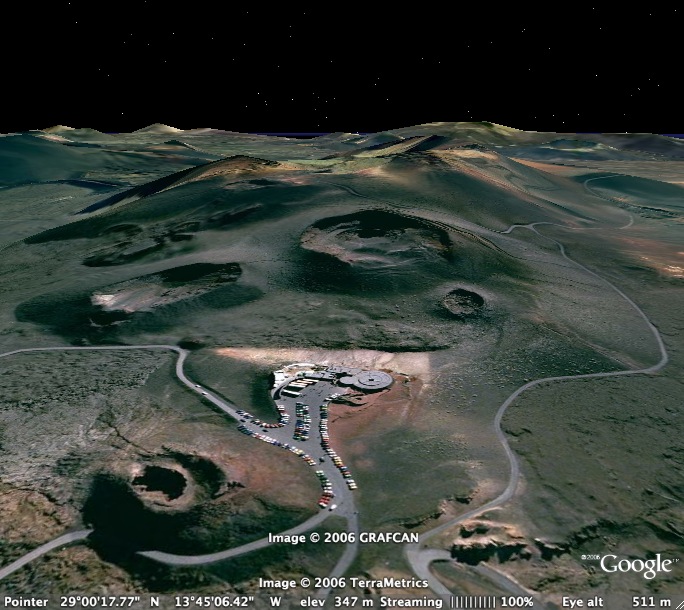
This is the (locally-) famous volcano barbecue on Lanzarote in the Canary Islands. We didn’t have any, but you can buy food cooked by geothermal heat there. You can see by all the cars outside how popular it is with tourists. And yes, the island does look like that. It’s a volcanic wasteland. I think it’s often used to film sci-fi movies.


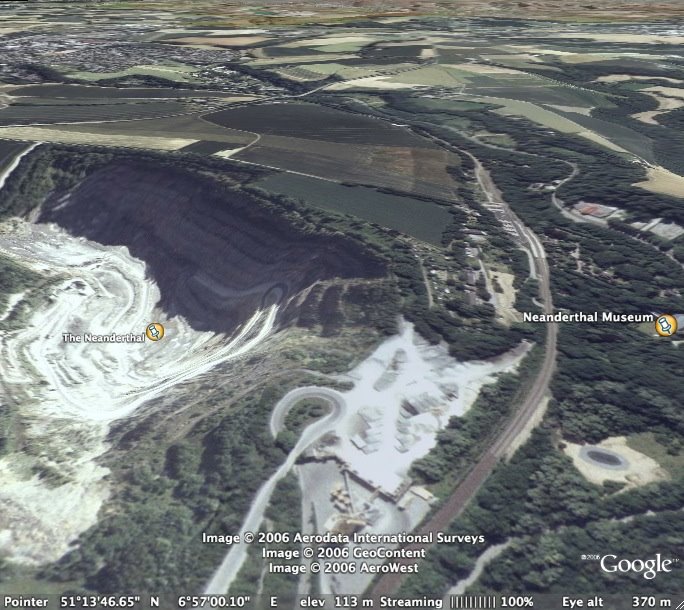
This is the Neanderthal (or Neandertal in the new spelling). The caves where the bones were found were part of a rich outcropping of bauxite or adamantium schist or Pop Rocks or something, so the actual discovery site is hovering somewhere in the air above that gigantic dug-out quarry. But there’s a pretty cool museum right nearby.


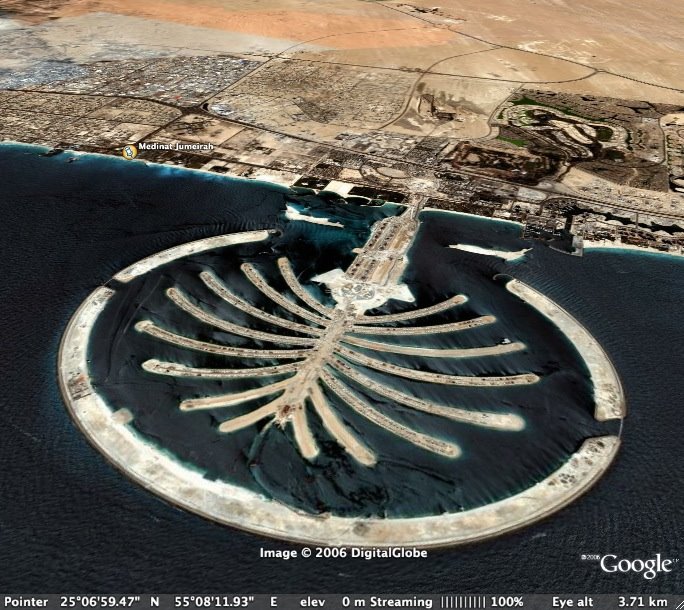
This is some of the gargantuan crazy-ass weirdness they’re furiously concocting over in Dubai, where Kim and I visited last year.


This is our apartment building and the school next door. It’s not a very long commute. I like living here.

Friday, September 15, 2006

The glamour’s off.

Now when I was a little chap I had a passion for maps. I would look for hours at South America, or Africa, or Australia, and lose myself in all the glories of exploration. At that time there were many blank spaces on the earth, and when I saw one that looked particularly inviting on a map (but they all look that) I would put my finger on it and say, ‘When I grow up I will go there.’ The North Pole was one of these places, I remember. Well, I haven’t been there yet, and shall not try now. The glamour’s off.
-
Joseph Conrad, Heart of Darkness

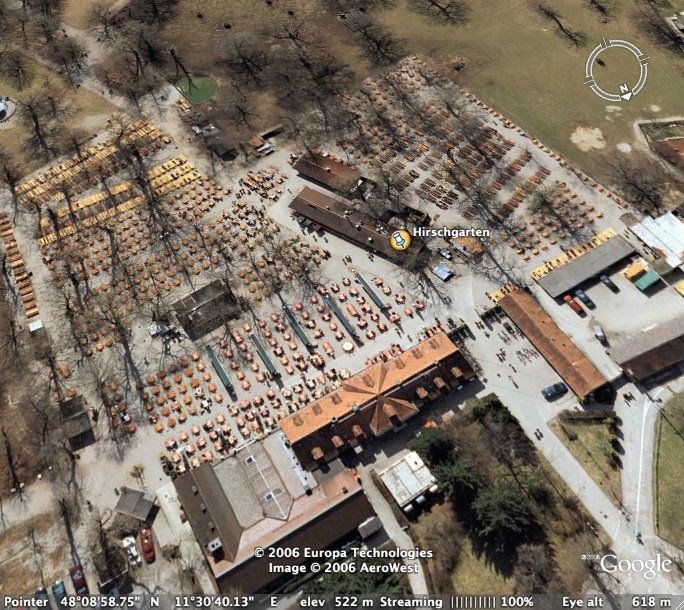
No time to write. Must go back and find an elementary school in Eugene, Oregon. Google Earth is beyond amazing. If you are at all interested in satellite photos of places you have been and your computer is fast enough, download the thing ASAP. I just started playing with it yesterday, and I more or less stayed up all night. I feel like I’ve only looked at a tiny fraction of the places I want to check out.

I think my favorite find so far is Neil and Sabine’s rooftop balcony/patio thing in Munich. You can actually see the junk on their balcony. Or the Hirschgarten. You can see individual people at the biergarten. I’m sort of giddy with excitement, and this is after like 5 hours straight of playing with the program. My right eyeball has practically burst from the strain; it looks like a maraschino and feels like it’s been dipped in battery acid. But I’m hooked.


Along with all of the amazement there is something slightly sad about the whole thing, though… in the vein of the Conrad quote above. I sort of feel like – that’s it?

That’s the entire world?

Being able to zoom around to any place on the earth makes it all seem a lot smaller somehow. It’s like when you return to someplace you’d been as a child, and it all seems so tiny and dull and different from the way you remembered it. I think Proust or someone compared memory to a light shining on only certain parts of a dark house. In some ways this program sort of turns on all the lights, full blast. Oh well. Anyway, back to finding and marking every possible place I’ve been in my entire life.

Thursday, September 14, 2006

l’enfer, c’est H4.7

There’s a word for sleepwalking. Is there a word for sitting in your sleep? Somnosedentary? I slouch drowsily in my swivel chair and await the distant thunder of basketball in the gym overhead.

The day stretches before me, long and mildly unpleasant, like a crusty baguette which smells of sweatsocks. As does this room. Haitch four point seven. I breathe deep, and inhale what may or may not be the mildewed funk of monkey feces festering in the drop ceiling. Through the tiny window in the door I watch the Doctor’s head bob in the distance. For some reason he’s wearing a neck brace. I don’t ask why. Yesterday he stood ramrod-erect in the hallway ringing a tiny bell for around an hour and a half. I didn’t ask why then either. I don’t want to know the answer.

The window in the door is my only porthole on this fluorescent-bathed sous-marin jaune. My next class is not for hours. By that time I’ll be cross-eyed and discombobulated from peering at this tiny, grease-smeared iMac screen. I should be doing my schoolwork, but I am not. I am working, yet not working. In the World Languages wing, no one can hear you scream. I am the substitute French teacher.

Je suis embarrassé, proclaims one of the children on the poster on the wall, his semicircular cheeks ablush. I thought that meant you were pregnant. Am I crazy here? Was I cruelly hoodwinked by Mme. Solonsky all those years ago? I hoist myself halfheartedly from the swivel chair and peer at the poster’s fine print. Made in Canada. It figures. The mystery deepens. Perhaps it doesn’t mean “pregnant” in Canadian French. Or does it?

The fiery-cheeked child on the poster seems to be laughing at me. The map of France, with all its stupid départements nobody’s ever heard of like Poitou-Charentes and Franche-Comte, also seems to be laughing at me. Why does French organization always seem so ridiculous? Maybe it’s the fact that they divided Paris up in a frigging spiral pattern. Next time you need a model for city districting, look further than your escargot shells, you buffoons. Once a civilization does something that colossally absurd on such a grand scale, it’s hard to take them seriously. Yet who’s the real buffoon here? I spent years learning French. Why didn’t my school offer Latin? It would have been a thousand times more useful. Ah but then who would be substituting today? Not I. Touché, smirks the political map of France. I’ve lost something, but I don’t know what.

The only sound is the drone of the air conditioner and the muffled tones of the Doctor rearranging his desk in his room across the hall. Since everyone’s on a field trip today he has less to do than I do, yet he’s constantly in motion. Even with the neck brace. I should be grateful for the distracting motion through the tiny window, but I am not. I resent it greatly. His head bobs in the window like a delicate pink ostrich egg wearing eyeglasses. And a neck brace.

After making a silent vow to Google whether or not embarrassé means pregnant, I succumb to the siren call of the swivel chair and return to the corner. For some reason, although the two A.C. units have been on full blast all morning, the desk is in a pocket of swampy, stale air. Over by the pregnant poster child the frigid blast from the A.C. was drying my eyeballs out. Here, four feet away, I am sweating like a pig.

I saw a monkey wearing a little belt in the courtyard yesterday. I don’t know why or how it got the belt. Was it kept as a pet? Being tracked in a science experiment? Or was it simply a fashionable little monkey? The musty smell from the drop ceiling seems to be getting worse. Those floaty things inside my eyeballs are back. Aside from them nothing moves. Even the Doctor’s head has vanished. If I died in here, I wonder how long it would take for someone to notice. The bobbing head reappears through the door window across the hall, and I grow nostalgic for those few minutes when it was gone. I sit and try not to look at it. I am gripped by a sudden wave of nausea. This silent, monkey-reeking room is driving me mad, yet I must remain. I am the French substitute.

Monday, September 11, 2006

The Gratitude of the Nunavutian

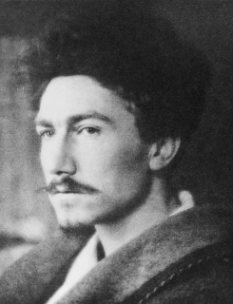
E.P. in 1913I have always been interested in the life and poetry of Ezra Pound. He spent his whole life pretending to be European and writing highfalutin poetry with a lot of foreign words just to prove how European he was – in spite of having been born on a farmhouse in Idaho. Through my years in high school and much of college he and his poseur-Euro pal T.S. Eliot seemed to me to be the bee’s knees. While I never read that many of them, Pound’s actual poems seemed pretty cool to me, especially that one about the subway and that one about the Chinese lady.

I now realize that Ezra Pound was an OK poet and a good influence on other poets, but aside from that a pretty complete failure as a human being. Outside a few isolated lines in his poems he showed almost no understanding of human feeling, and he eventually became a raving anti-Semite and Fascist and died a reviled and lonely man who only escaped execution because he claimed to be a lunatic. His poems are full of interesting language but are in some ways ultimately meaningless, because they exist only to show off how what a smart guy Pound thought he was and how many different languages Pound thought he knew.

Why do I bring this up? Looking back upon my few posts here I see they’re full of things like real-time strategy games, German heavy metal bands and tumors – none of them particularly warm and fuzzy.

Except for the tumor, and that’s really more hairy than fuzzy.

So, in honor of it being Canadian Thanksgiving today, I hereby dedicate this post to something emotional and heartfelt. I would like to briefly express my gratitude to the people who have helped me the most.

I’m thankful for Kim, for being my best friend and everything else for the past decade or so.

I’m thankful for my parents, for having raised me very well indeed and for continuing to always be there for me. On top of everything else you taught me important things such as respect and compassion for others and the importance of the Golden Rule, and while I might not always succeed your examples are always in my mind.

I’m thankful for my little sister and brother, for sharing their great senses of humor and intelligence with me over the years.

I’m thankful for the friends I met at Fast Train this summer, who were such fun to be around that I felt like an undergrad again – and a slightly less unpopular one this time around. I wasn’t even spat on once, which is more than I can say for my time at UConn.

A typical Canadian ThanksgivingI’m thankful for everyone at the school here in KL, for giving me so many great chances to learn to become a teacher, and for being such good friends outside of school.

I’m thankful for Mithra, Frank, Neil, Sabine, Martin, Trish, and everyone else at WorldGuide and MIS back in Munich, for their friendship and help over the past five years.

I’m thankful for Justine, Carolyn, Steve, Mary, Ted, and everyone else at CTI, for making my first job out of college so much fun every day.

I’m thankful for Mark, Bill, Larry and everyone else at The Hartford Courant, for their patience with me during three great summers.

I’m thankful to all my teachers and professors over the years, and am sorry for all the times I didn't pay attention to what they were trying to tell me, both about school and about life.

I could go on forever here, but that’s a start. And as for literary Europhile Americans to emulate, these days I hope to be slightly less like Pound and Eliot and a little more like Henry James; not in terms of style or anything, but in emotional perception and introspective honesty.

Friday, September 08, 2006

early adopter

As you know, I’m pretty much always point man in the vanguard on the forefront of technological innovation. I was rocking a Buick-size vibrating pager back in ’73. While still a mewling, puking toddler, I instructed my caretakers to invest several hundred thousand dollars of my ancestral inheritance to have a working Fremen stillsuit prototype fitted, to efficiently harness and reuse my toxic bodily discharges. My web page had reached over seventy thousand hits daily long before Steve Jobs donned his first turtleneck, and I constructed a rudimentary iPod of twigs and bark at the age of seven. Since then my level of tech hipness has been growing daily, swelling and bulging and festering into a 70-pound abdominal tumor. With teeth and hair. Of pure hipness. Metaphorically speaking.

However, somehow my unerring compulsion to prance majestically on the razor-sharp cusp of the bleeding edge failed me on the subject of blogs. Until about two weeks ago, I assumed that all blogs were complete and utter blollogs blollocks garbage.

Sure, I’ve stumbled across them here and there over the years, but never gone back again and again to read any particular one. The word “blog” alone was grating enough to make me look the other way – and then people started talking about the… ugh… “blogosphere”. I can’t go any further into how I feel about that term, because I’m worried about this vein in my forehead. In short, I never saw any redeeming features to the things until Kim started seriously researching their use for education this year.

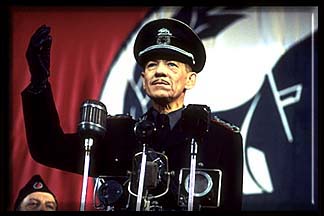
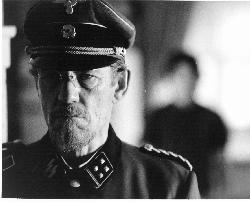
All that was by way of admitting that I’m hopelessly behind and trying to catch up. Tonight I found that two people who (whom?) I used to think were pretty cool about 12 years ago have blogs. Perusing these sites has pleasantly reminded me of why I thought their authors were cool in the first place. These two mid-90s heroes of mine are: author William Gibson and Myst designer Robyn Miller. I’m sure everyone who cares knew about these a long time ago, but give me a break, I’m learning. Also for some reason thinking about William Gibson and Neuromancer got me thinking about Dune, hence the picture of Baron Vladimir Harkonnen above. Sorry.