Thursday, November 30, 2006

Cribs: Mongolian Edition

Since winter is approaching and it’s difficult to get in a wintry mood here in Kuala Lumpur, I’ve taken to looking for the most desolate and godforsaken frigid wastelands I can find on Google Earth, to get me in the holiday mood. I’ve been checking out fjords and icebergs and the Faroe Islands and so on.

I recommend the area around the Kamchatka Peninsula for a true scene of bitter, soul-crushing emptiness – I can’t really tell but I imagine most of what I see is fishing villages, oil outposts and Soviet military bases. So I assume everyone there probably looks a lot like Santa, except with fewer sleighbells, toys and jollity, and more vodka, knife fights and Russian Roulette.

So let’s take a little gander at a place I assume is pretty cold and desolate, Ulaan Baatar, Mongolia. I don’t remember the name having those extra “a”s when I was a kid. Maybe the city’s growing. I can only hope I live long enough to see them add a third and possibly even fourth “a” into the mix.

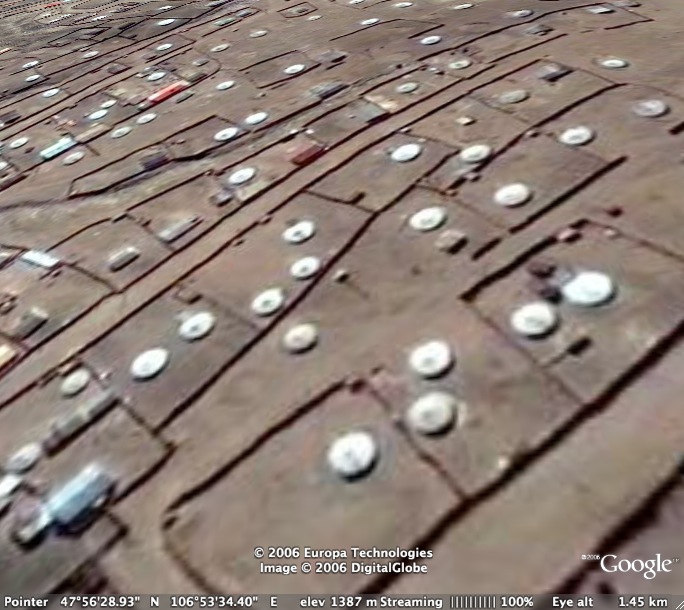
Here’s the city. Looks small and dusty, but presentable. There’s a big central square, a soccer field, and what looks like residential sprawl on the hills around it. Much less exotic than I was expecting. Maybe a closer look will show some local color.


Let’s zoom in on those hillside residences, shall we? Take a gander at how Ulaan Bataar’s middle class like to set up their cribs, just a few hundred yards from the bustling capital’s heart. Oh dear. Those aren’t... They can’t be...


They are. Tents.


Everyone apparently lays out a nice little yard with a big stone wall around it, and then sets up their yurt. Er, hello, Mongolians? Far be it from me to tell you how to live your lives but dudes if you’ve got the massive shipments of bricks and mortar for those sturdy fences you know what else you can do with them? BUILD A F&#KING HOUSE. Oh well. Sarcasm and cultural insensitivity aside, it’s pretty cool that they still live in those tents, even just outside the dead center of the capital city. ’Cause that’s how they roll. That’s probably what suburban Chicago would look like today, if we hadn’t kicked out all the Indians. Except with teepees, of course.

Here is a picture I just found of what those white circles in the Google Earth pictures must be. As I suspected, yurts, yurts and more yurts. Yurtles all the way down. Note that it clearly has a concrete foundation. Oh you wacky Mongolians.

Friday, November 24, 2006

Al O’Limerick


Wherein I try my hand, not once but frice... er, force?... four times, at an auncient Irish verse form as time-honoured and venerable as the beloved Shamrock Shake:

1. The Moistened Pedagogue
Malaysia: a substitute teacher
had sweat as a notable feature.
He sweated all day
tried to wipe it away
Others said, “what a damp, smelly creature.”

2. Customs Officials
or
Sure, Use Up an Entire Page of My Passport for One Stamp, You Stamp-Happy Ass

When traveling in Indonesia
The visa fee might well displease you
It’s thirty-five bucks
yet the government sucks…
Where’s that money go after they squeeze you?

3. Formatting Fatigue
I find it a tedious trial
to write things in APA style.
I forgot to indent
and down my grade went
I’ll be angry about it a while.

4. Bistromath
When having a restaurant luncheon
The math at the end doesn’t function.
When your friends add their share
the result’s far from fair
And you stifle the impulse to punch ‘em.

Monday, November 20, 2006

the courage to hate the olympics

I’m a vigorous, lusty man of grandiose gestures and consuming passions, and I live life to the fullest. Sometimes I sit for long periods of time, and – this is where it starts to get tricky; don’t try this at home – sometimes I lie down for long periods of time. As if that weren’t enough, sometimes I even play video games while sitting or lying down. One of my many extreme sports hobbies is interactive fiction.

Interactive fiction is basically just a fancy term for text-based computer games. They were popular in the 1980s. The most well-known game series was called Zork. I always liked these games because, like reading a book, they allow you to use your own imagination to picture what’s going on. Only within the last couple of years have video games started to have good enough graphics to compete with the mental pictures I used to draw when I played text adventures. Anyway, I’m still quite interested in the genre and often re-play old games or try some of the new homemade games being created by enthusiasts. I even programmed a very short game myself in Inform 6 for a grad school project this summer.

Anyway, while I was looking around at online interactive fiction resources the other day, I came across the writings of a text game author, a Mr. Stephen Bond, and to my surprise found that there is actually someone who’s more critical than I am. This guy hates the Olympics. That takes a certain pessimistic genius, and my hat’s off to him. I can’t argue with him, either – The Olympics do pretty much suck; I just never would have dared to take such a bold ideological stance on my own. I have no point here except that I wanted to give him a shout-out for providing me with some funny and thought-provoking reading material. Here’s an excerpt from a post I particularly liked, called “how to recognise people who try to command, control and influence people”:

The Only One in Control
The schemer must always appear in control of the situation, even when the situation does not require control of any kind. In fact, schemers usually lose control of things in a real crisis, but that is beside the point. One way in which the schemer maintains the appearance of control is by making out that the surrounding people are losing it.

For example, a schemer may tell someone to ‘take it easy’, even when that person is taking it easy, or say ‘Relax, we have plenty of time,’ even when the other person is relaxing and is well aware that there is plenty of time. Other typical phrases are ‘It's important that we maintain a sense of focus here,’ and ‘Let's keep our minds on the task at hand.’

Hypnosis
Schemers believe that they can bend other people’s wills by the power of mind alone. They are often seen attempting a form of hypnosis, which involves staring at someone in the eyes, addressing them by their first name, and telling them to do something.

“Tony, you'll do that for me, won’t you.”

The hypnotism attempt is sometimes accompanied by a pat on the back or some other physical contact. If the victim is demoralised enough, the hypnosis will actually work.

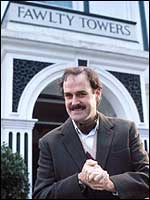
The Fawlty Tow’r

Why does everyone who wants to force themselves into a prefabricated poetic form have to write haikus all the time? Screw haikus.

Why not try to funnel our poetic juices into another juice box, as it were? I choose to let the capricious sun of inspiration play a high C until I live to be 100 Plus. Tetra Pak. NO MORE JUICE BOXES, CHLOE.

Crap. I’ll start again.

One of the many books I’ve started but not finished is The Faerie Queene by Edmund Spenser.

One of the many reasons that I haven’t finished reading this book is the strange and extremely restricting meter in which the poem was written. It has to be one of the most convoluted ways to write a poem I’ve seen. Here’s my first and so far only shot at a single stanza of Spenserian metre. Now keep in mind that old Spenser wrote about a jillion stanzas using the exact same rhyme scheme. No wonder his epic poem doesn’t make any damn sense. Anyway, here’s my one stanza. It’s a true story of a 21st-century manchild and his quasi-legal downloading:

Tonight I sought to burn a DVD
Containing episodes of Fawlty Tow’rs.
But what should I upon exam’ning see?
The disc could hold but one and one-half hours!
I’d thought these discs possess’d quite greater pow’rs.
Three episodes at most a disc would fit!
Thus my enthusiasm for it sours.
Now on my hard drive those old shows will sit;
I watch the tiny screen and feel an utter twit.

Monday, November 13, 2006

The Ruiner’s Lament

Kim calls me a “ruiner” because I’m so critical of everything. And because I’m often quite crotchety. And because I’m prone to believing critical movie and book reviews, even if the reviews are clearly written by blithering idiots. And because I’m prone to telling her what she feels are crucial details about the endings to things before she’s seen them. Hm... now that I think about it I suppose there might be a teeny tiny speck of justification for the title of ruiner. I certainly believe in preemptively detesting everything and everyone until I see clear and incontrovertible evidence of nonsuckiness.

Well, the spoiler has been bespoiled. I’ve been hoist on my own petard. A petard is a type of bomb named after “a loud discharge of intestinal gas,” by the way. Just because something’s in Hamlet doesn’t mean it’s not naughty.

Anyway, I’ve gone and done ruined something for myself, and that something is several of my very favorite poems, including the well-known “The Lake Isle of Innisfree” by Yeats and “Skunk Hour” by Robert Lowell. I do not claim to have particularly refined or obscure taste in poetry; both of these are over-anthologized poems which most students are made to study at some point. I know I saw both of them ad nauseam in both high school and college, and strangely they never got old and I liked both very much indeed. Then came The Spoilening.

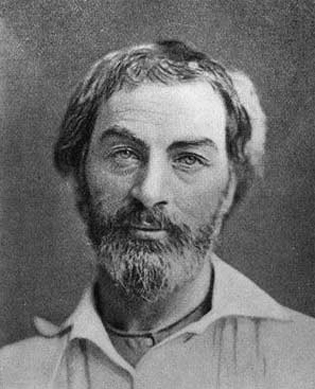
I recently acquired a copy of what Amazon calls In Their Own Voices: A Century of Recorded Poet [BOX SET] (I guess they’ve still got some kinks to work out of their titling system). It’s just what it sounds like, a set of recordings of poets reading their own work. The first one is Walt Whitman, apparently recorded on the very first record player Thomas Edison ever built – you know, the one made out of granite and powered by human blood. It’s an interesting and valuable piece of history, and a priceless record of one of America’s greatest poets.
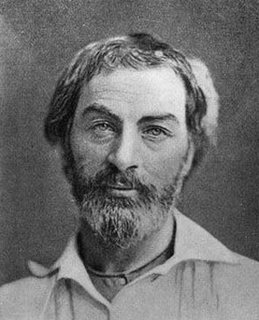
Now future generations will know that Walt Whitman sounded like a big women’s blouse. (If you have Windows Media Player or RealPlayer, check out the samples on the Amazon page and see hear for yourself. I’m currently using a Mac and I vowed never to install RealPlayer again many years ago because of the stupid ads and extra programs they keep trying to rope you into, so I can’t vouch for whether or not the samples prove my point, but I’ll pretend they do.) I don’t know if it was the recording, or if old Walt was 90 when they recorded him, or if he just sounded kind of silly when he talked, but he has kind of an Elmer Fudd/Woody Allen voice. The line of powerful and stirring adjectives “Strong, ample, fair, enduring” from the poem, when read by its creator, sounds like “Steh-wroang, eaample, faiah, endoooring”. It sounds a lot less like a rousing ode to a great nation by a master poet and a lot more like Linda Richman from Coffee Talk getting verklemmt.

This, sadly, was not the most disillusioning of my discoveries. For whatever reason Whitman sounded kind of wimpy, but Yeats, doing “The Lake Isle of Innisfree”, has an entirely different problem.

In case you’re not familiar with it, “The Lake Isle of Innisfree” is the most peaceful and meditative poem about harmony with the natural world ever written by a non-Japanese person. It’s about having a calm quiet place to think about, about calmly hearing the sound of water lapping on the shores, even when you’re in the grey city. It’s lovely and very, very peaceful and soothing.

The problem is that when Yeats, the author of this pleasant, soothing poem, reads it himself he bellows it out as if it’s Judgment Day. He has a booming “Grrreat Poetick RRRRECITATION!” voice that sounds as if he’s Moses reading the Commandments off the stone tablets. He sounds like Saruman on his little oration balcony at Isengard getting the Uruk-Hai really whipped up before they go and pillage something. Which would be great for many of Yeats’ poems, “The Second Coming”, for example, but which is just really, really crappy for “Innisfree”.

It’s such a soothing poem when I read it on the page. “And I shall have some peace there, for peace comes dropping slow…” But when Yeats reads it, it’s like he’s just getting to the last line of a campfire story about hobgoblins and banshees: “FeRRRR PEACE… comes DRRRRRROPPING slO-O-O-O-O!” I understand that he came from an earlier time, when poets probably all had a sort of powerful Master Thespian declaiming voice they used, but now when I think of the poem, or even just see the words on a page, I think of that old man’s furious growling voice. It’s exactly like sitting down for a session of Zen meditation and hearing Gandalf hollering “YOU. SHALL. NOT. PASS!” every time you close your eyes. It’s just ruined it.

I won’t even go into what I think of Robert Lowell’s nutball voice. Let’s just say I liked “Skunk Hour” a lot more when I didn’t have the unforgettable mental image of it being read aloud by an effeminate Mayor Quimby.

Wallace Stevens on the other hand didn’t ruin his poem at all. I pretty much would have figured he had a silly voice – I mean, when you name a poem “The Emperor of Ice-Cream” and include the lines “bid him whip/
In kitchen cups concupiscent curds,” you’re setting a certain circus-tent vibe from the get-go. So he’s fine in my book.

And then there’s Ezra Pound. That enormous poseur. Tell me if you hear this, but I could swear that he’s exactly copying Yeats’ “Grrreat Poetick RRRRECITATION!” voice and rhythm. Maybe young Idahoans back then sounded exactly like elderly Irishmen, I don’t know, but it definitely seems suspicious.

Ruined. All ruined. Damn you, today’s modern multimedia world of the future! Damn you to Hell, sir! Now I’m wondering what else I like in written form that would suck if I heard it aloud by the author. Maybe Dante sounded like Bobcat Goldthwaite. Maybe Abraham Lincoln sounded like Rosie O’Donnell. ARGH.

Now, I know I have been harsh on these poets’ voices, but I’m not saying that I would sound any better if I read poetry aloud. Au contraire, mon frère. On the few occasions when I’ve heard my own voice on the answering machine, I’ve been filled with an urge to punch myself in the head so that no one would ever have to hear that awful voice again. I’m just saying that I’ve discovered that some poetry is MUCH, MUCH better when left on the page. Again, I urge you to listen to the samples yourself and let me know if you agree.

In any case, I will never hear those poems the same way again. And thus, faire Reader, was the Naturall Order turn’d upon its Arse, and the Ruiner him Self Ruin’d.

Tuesday, November 07, 2006

Shantih Shantih Sieg Heil

I’ve already done a post about something I saw on Bali that combined European culture, modern Asia and Sanskrit word origins (chess). Oddly, that was merely the second most mind-blowing thing I witnessed on that trip which combined those exact same fields of interest. If you are someone who does not already know Sanskrit but who happens to be as interested in connections between far-flung words as I am, prepare to be thunderstruck. Both of you.

As we were being shamanistically blessed by a woman along the side of the road (it was the van driver’s idea, and is a good example of why a trip to Bali does have redeeming features, despite what my lovely wife might say), she came up to my window (the Balinese witch doctrix, not Kim), smeared some grains of rice on my forehead, and reverently said to me: “Om Swasti asti blabitty blah blah blah…”. There was a lot more to the blessing than that, but who cares.

I knew the old Hakenkreuz was an ancient religious symbol – but I didn’t know that the exact same word more or less was still a friendly everyday greeting on Bali. What the heck? Then it hit me – and this is the moment of utter jaw-dropping etymological pyrotechnics – if “swasti(ka)” is some sort of cheery salutation then maybe, I thought, it’s the same thing as hello in Thai; “sawadee ka”.

It was like the globe had just twisted into a Klein bottle. Nazi soldiers and Thai monks went around saying the exact same word several times a day? That’s insane. That’s like learning that “colostomy bag” means the same thing as “fuzzy bunny”. A similar revelation which blew my mind back in the day was that “Aryan” and “Iran” are more or less the same word, but this swastika thing stretched even further across the globe, and was even more bizarre.

I haven’t actually found that much direct information yet about the connection between swastika and sawadee ka. If you happen to know anything on the subject let me know. Maybe the “ka” suffix part is just a coincidence and only swasti is really a leftover from Sanskrit, I dunno.

Friday, November 03, 2006

Sam Sees an Oliphaunt

In Bali recently I saw dozens of pairs of people sitting on the sidewalks in front of their souvenir stores and playing chess. I thought that this was really neat. I assume that the trend got started because among the souvenirs that the Balinese mass-produce are wooden chess sets, but even so there was something fascinating about seeing non-Westerners playing chess for fun. I suppose I’ve got a stereotype of chess as a highly refined and intellectual European pursuit, to be carried out in utter silence by perspiring Slavs or Icelanders with rumpled suits and enormous egg-like craniums. Seeing this reminder that this was just a stereotype and that it’s a fun game for just about anyone was quite inspiring. I’m trying to brush up on my chess skills. It is, however, difficult to polish a turd. I’m horrible at chess. It requires long-range strategic thinking which, as Kim knows from when we’re planning vacations years in advance, is difficult for me. But anyway, I’m working on it.

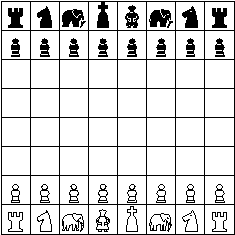
So anyhoo, a little internet research on the history of chess and what do I find but something INCREDIBLY INTERESTING. At least to me. The bishops are supposed to be elephants!

From this website on the Indian game which is apparently the direct ancestor of our chess set:

The pieces were raja (king), mantri (counsellor, ancestor of the ferz), gaja (elephant, later called fil), asva (horse), ratha (chariot, later called rook), and pedati (infantry or pawns).

The elephants/bishops used to move a little differently; if you have Java working properly you can play the old version here.

Not only is that little historical background into the pieces interesting in itself, but those Sanskrit or whatever names of the pieces are quite meaningful too. “Raja”, “Mantri” and “Gaja” are all still Malay words, and “Ratha” and “Pedati” really show their indo-european origins. We also used to eat at an Indian restaurant in Munich called Radha which I believe was supposed to mean “chariot”. As if that weren’t enough, “Mantri” a.k.a. Menteri or minister in Malay is supposedly the origin of the word “Mandarin”.

Overall I think I like chess better now that I know the pieces are all supposed to represent actual military field units and not some weird lathe-turned royal family out on a pleasant stroll with their favorite priests and a couple of self-propelled castle towers. Au contraire! Chess is the prequel to Advance Wars.

Tuesday, October 31, 2006

Cosmic Karma, Cosmo Kramer and Underpants Ecstasy

On Bali last week we had a tour guide, Darma (yes, as in Dharma), who had a lot of very insightful stories about growing up in a rustic Balinese village, the island’s traditional society, and the challenges and changes his island faces. For someone wearing a tight-fitting blue tracksuit and who seemed to be concealing a dark past in the Javanese cruise-ship industry, he was remarkably wise.

During our tour, in between un-called-for and frankly gut-wrenching attempts to get us to laugh at a ghastly pun which involved asserting that “BBC” stood for “bananas, bamboo and coconuts”, the puckish yet insightful Darma lucidly described the way that the close-knit village unit perpetuates and preserves traditional Balinese life and ritual, and it really got me thinking. What proportion of what we see as the great achievements of humanity was simply due to old-fashioned peer pressure?

In other words, would any human society, religion, or cultural system of any kind have been possible without the nosy neighbor? I’m not so sure. In fact if you think about it, until recently in almost every nation on Earth, the idea that one of the main points in life was not doing something which would shock the neighbors was the glue which kept the world running. It’s how pyramids and cathedrals got built. Shame. Guilt. Conformity. Religious obligation. Rituals. Holidays. Mass gatherings. Belonging. Ancient Athens, the birthplace of democracy, was also the birthplace of ostracism.

Now, however, mainstream American society is currently based on the idea that nosy neighbors should mind their own damn business, and in fact are liable to get a cap in their ass if they get too nosy. We were raised to believe that the other people around us have no right to tell us jack, and are simply useless lumps to be ignored, exploited or possibly pumped full of lead on our quest to become a President, a billionaire or both. We’re encouraged to think that each American citizen should personally invent his or her own entire outlook on life from scratch without consulting family or the neighbors at all.

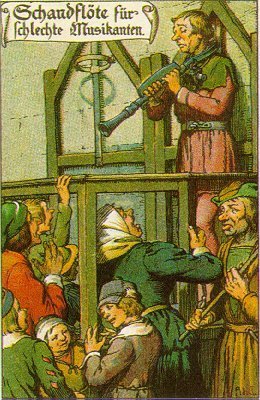
As a lifelong ostracised oddball and someone who deeply, deeply detests conformity for conformity’s sake I can’t believe I’m saying this, but I’m starting to wonder if maybe a little more German-style shame wouldn’t be an improvement on the current US outlook. I’m not advocating a return to putting people in stocks or forcing them to wear the shame flute, but I am starting to think that there must be a happy medium in between the antisocial American “individualism at any cost” ideal and the Balinese-style community and religious web of obligations and rituals.

I sometimes wish I had more traditions in my life so I didn’t feel like the proper way to spend an afternoon off is to sit motionless in front of the TV in my underwear. But on the other side of the argument, there are probably thousands of Balinese people who wish with all their hearts they could renounce their majestic time-honored religion and colorful rituals and just sit around in their underwear all day. The answer probably lies somewhere in between, in that magical, elusive place where ancient superstitious ritual meets modern jockey shorts. I think that’s where I want to be.

Saturday, October 21, 2006

The Pregnant Sheep

A Short, Short Story

Written as a writing process project for one of my graduate school classes.

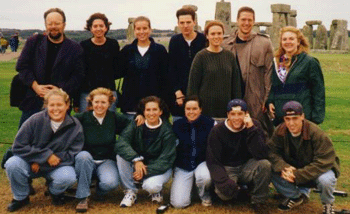
The northern wind chafes my nose and ears. It’s bitter cold on the barren ridge. The rest of my group is clustered downhill, away near the bus. When the wind picks up, I can’t hear them at all. I will myself to believe that it’s two thousand years ago, that I’ve been assigned to guard this frontier against the barbarians. It doesn’t work. Sleepy, hungry and growing cold in spite of my sweater, I am undeniably here, now, in my head, with my thoughts – and my imagination is clearly out of order. Hadrian’s Wall, once a triumph of military engineering, is too low and mossy to seem anything other than quaint. I feel transfixed in the present, and it’s impossible to forget the rest of the group, or the bus. Picking my way unsteadily along the low, broad, jumbled top of the Wall – am I supposed to be doing this? – I move further from the group, and from Kim.

The muted, autumnal English countryside all around is beautiful, but I feel disappointed in the site, in my lack of imagination. This same feeling of curdled anticipation was even worse at Stonehenge earlier this year. I felt nothing looking at it. That’s not true – I felt betrayed. The rocks looked small and somehow artificial. This is less of a letdown, because the Wall isn’t as iconic a sight, but it’s a similar, familiar feeling. I know that berating myself for insufficient awe is absurd, that I should just relax and take everything in, but it’s no use. I’m so preoccupied with analyzing my own feelings and worrying about idiotic details, like a tooth that seems to be getting sensitive and a floating thing in one of my eyes, that I am unable to enjoy the moment. I look away from the bus, off into the fields and into the misty distance. It seems as if it might rain soon. The floating thing inside of my eye bobs up and down in agreement.

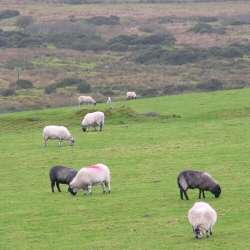
A small flock of sheep is grazing on the hillside, with the ancient Roman wall serving as boundary of their enclosure. I hop down from the wall because the next section is too dilapidated to walk upon, and I see a sheep, perhaps 15 feet away, sprawled motionless on its side. Its hindquarters are towards me, and I can see that it is giving birth. Part of a wet membraneous sac is protruding from the sheep, and as I approach I can see the damp folded limbs of the lamb inside. The mother sheep is breathing rapidly, and its eyes are rolling wildly in its head. I stand motionless and watch for a minute. I have never seen anything giving birth firsthand, at least not that I can remember. After some unproductive spasming the ewe’s breathing slows, and its head drops to the damp grass below. It’s clearly exhausted. Kim comes up and we watch together. Neither animal is moving very much, and the mother is breathing very slowly. I have no knowledge of ovine obstetrics but something about the resigned rise and fall of its ribs, the limp splay of its legs on the brownish turf, makes me think the mother sheep has been trapped here in the same position for quite some time. Perhaps hours. “Maybe I should pull out the baby or something – like they always do on TV,” I venture. “Maybe... I have no idea,” Kim says. I stare at the sheep for another minute.

This was my first trip to the north of England. We had all driven up that morning in the bus from Ambleside, in the Lake Country. I was studying abroad in London for the semester, and this was our big group trip. The lakes and Hadrian’s Wall. The Lake Country was beautiful, and we’d just seen Wordsworth’s cottage. These might have been boring destinations for most 20-year-olds, and indeed probably were for some of my classmates, but my girlfriend Kim was visiting and we were enjoying the time together. The long hours in the rented bus (or “coach,” as they called it), however, made me feel queasy and detached from everything. I had always been interested in Roman history, and Roman Britain in particular. Back in London I had sought out museums and sites with Roman remains. But it seemed like a chore to muster enthusiasm for Hadrian’s Wall.

I had trouble mustering enthusiasm for a lot of things that year, actually. Living and studying in London had been wonderful, but as the year had progressed I had been feeling more and more distant from the world around me. I was friends with several of the people on the program, but only up to a point. I enjoyed my classes and exploring London’s streets, but I also felt overwhelmed easily and spent a lot of time reading in my room. I had hardly taken any trips outside the city, and I felt guilty about not taking better advantage of being abroad. When I had free time I would take long walks through the city, usually ending up in a record store and often buying CDs, which was another occasion to feel guilty. They had CDs back in America.

Thus, on the trip to Hadrian’s Wall I was feeling very strange after several months of exciting, educational London life which was, somehow, becoming tainted by vague, creeping unease. The fact that Kim was there made me feel much, much better, but I still felt slightly odd, as if I were watching the world from behind a pane of glass. The long bus rides behind an actual pane of glass didn’t help.

I look at the panting sheep, unable to come to a decision. Aside from our group there’s no one in sight for miles around. I certainly don’t see a gruff farmer or kindly local vet. Kim looks up at me. A chain of thoughts rush in circles through my head.

The sheep seems to be having trouble giving birth.
Should I help in some way?
I have no idea.
I don’t want to get my sweater dirty.
What if I made things worse?
I wouldn’t want to be responsible for a dead lamb.
Better not to interfere.
Maybe I would pull too hard and pull its leg off or something.
And what if I got goop on my sweater?
I just bought this sweater.
It wasn’t an expensive sweater, but I’d have to first take it off.
And then my hair would get all messed up.
Or I could push up the sleeves...
But then wouldn’t the elastic on the wrists get stretched out?
Is this sweater wool?
Maybe I could sort of poke it with a branch, or...
No, it would have to be hands-on.
What is that stuff? Placenta?
Forget it. This is none of my business.
That’s just an excuse. You’re just scared.
But it’s none of my business.
I’ve seen several instances on TV where someone had to pull a baby farm animal out of the mother.
Shouldn’t I do that?
But I have no idea what to do or how to do it.
What would I do with my sweater?


I do not move. I do nothing. The mother sheep’s side slowly rises and falls as it labors to breathe.

As far as I know, I am sentencing both animals to death. Standing and thinking instead of helping. What’s wrong with me? Do other people have this problem? I get a nauseous feeling that tells me that somehow I’ve made the wrong choice, but I can’t make myself do it differently. I’m still standing just feet away but somehow it’s already too late. I had a choice, and I did nothing, simply because doing nothing was the easiest thing to do. I wonder if I saw a human being in need of help, if my nerve would fail me like this. How can I make myself do the right thing? My current method clearly needs work. I’m disgusted at my hesitation, but instead of spurring me to action the disgust makes me want to put the whole situation behind me.

A thought flashes: I haven’t turned away yet; maybe there’s still a chance. Forget the damn sweater and just pull on that baby lamb placenta or whatever that is. The moment passes. The pane of glass descends, the floating thing in my eye pirouettes with glee. It’s time to put this all behind us. As I turn away I feel a dull, toxic satisfaction in having taken the easy route, a poisonous contentment that blossoms black and oily within my brain. I begin to forget that I ever had a choice to make. There was nothing that could have been done. It was none of your business.

“Let’s go back to the bus,” I say to Kim. “I’m getting cold out here.”

Friday, October 13, 2006

Second Life Kind Of Sucks

I have been hearing about this online multiplayer thing called Second Life for a while, and I thought I’d check it out. Big mistake. It goes VERY VERY slowly, at least on my connection, and the program crashes about once every ten minutes. But it seems interesting enough that I keep wanting to try to get it running again, so I get trapped in a hellish, tantalising cycle of waiting and crashing and more crashing and then even more further crashing and rebooting the likes of which have not been seen since I tried to run Rebel Assault on my old 486.

The idea is, people can buy virtual real estate for ten bucks a month or whatever and sublet it, and also create any sort of items they want in the simulation and try to sell them to other people, so the bottom line is the thing supposedly has a GNP of 64 million $US. Seems interesting. I’m not sure I see how the economy works yet. People being what they are, I assume people have found some way to use the simulation for pretend sex while pretending to be various furry animals.

But as I say, it hardly works on my computer. At this point, I’ve got all the graphics options turned as far down as I can get them, and I seem to be barely able to inch my little guy around at a snail’s pace. Half the time he keeps walking in one direction forever and ends up at the bottom of the sea. And then I get booted out of the program. So if you have a fast intarweb connection and a good graphics card, please check the thing out and report back to me. It’s free to create a little character guy. Mine looks more or less like me when I’m dressed for work, except for the tiny details that he doesn’t have glasses and I have him CARRYING A MUTHAFREAKIN SWORD. I really wish the program worked better for me, because strolling around as a virtual version of myself with a goddamned sword is pretty much my lifelong dream.